
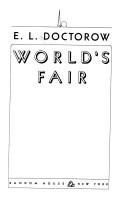
World's Fair
E. L. Doctorow · 1931–2015 · United States
Why it matters
A boy growing up in the 1930s Bronx navigates family secrets and the wonder of the 1939 World's Fair in a novel drawn closely from Doctorow's own childhood. His National Book Award winner turns personal memory into collective Depression-era mythology.
At a glance
A child narrator's clear, direct voice makes for an accessible, fast-moving read.
Deep dive
Nine-year-old Edgar spends the last years of the 1930s absorbing his realist mother's worry and his dreamer father's failures in the Bronx, and E. L. Doctorow lets a single afternoon at the 1939 World's Fair become the whole family's argument about what America is actually promising anyone.
Written for readers who have finished the book. No plot recap, and nothing here is safe to read first.
Themes & symbolism
Doctorow narrates most of World's Fair through Edgar Altschuler, a bright, anxious nine-year-old absorbing the texture of late-1930s Bronx life, stoopball, radio serials, an obsessive idolization of Joe DiMaggio, while registering, without fully understanding, the mounting tension between his mother Rose, whose realism is really a defense against her husband's chronic financial failures, and his father Dave, a phonograph-and-radio salesman whose optimism keeps outrunning his actual prospects. Doctorow periodically interrupts Edgar's close, sensory child's-eye narration with first-person passages from Rose, Dave, and other relatives, a structural choice that keeps reminding the reader how much of family life a child registers without yet possessing the context to interpret.
The 1939 World's Fair itself, with its slogan "The World of Tomorrow" and its exhibits promising a gleaming, streamlined, thoroughly modern future, arrives late in the novel as the culmination of everything Edgar's Bronx childhood has been quietly rehearsing: a national fantasy of progress and abundance staged directly alongside a family barely keeping its own household solvent. Doctorow doesn't editorialize the gap, he simply lets Edgar experience the Fair's wonders, the Trylon and Perisphere, the Futurama exhibit's model highways, with total sincerity, letting the reader supply the irony a nine-year-old has no reason yet to feel.
The Westinghouse Time Capsule as the Novel's Template
The actual 1939 Fair buried a time capsule of contemporary artifacts meant to be opened five thousand years later, and Doctorow builds the novel's closing image directly from that real historical gesture, letting Edgar's own private ritual of preservation answer, on a child's scale, the same impulse that produced the Fair's most famous exhibit: a need to believe the present moment is worth explaining to somebody who isn't here yet.
Rose's Counter-Narration
Doctorow gives Edgar's mother Rose her own extended first-person chapters recounting her parents' immigration and her own hard, disappointed girlhood, material Edgar himself has no access to and could not yet understand if he did. Setting Rose's harder, more skeptical memory directly against her son's wondering present-tense narration lets the novel argue, quietly, that the optimism a child mistakes for simply how the world is has usually been paid for by an adult's much less innocent experience.
The last seal: what actually happens, and why it lands the way it does.
The ending, explained
In the novel's final pages, having absorbed the Fair's spectacle and his family's quieter, ongoing financial anxiety in more or less equal measure, Edgar buries his own homemade time capsule, a small collection chosen with the deliberate seriousness of a child assembling evidence: a Tom Mix decoder badge, a short biography of Franklin Roosevelt he wrote himself, a harmonica, a torn stocking of his mother's. Doctorow doesn't resolve the Altschulers' financial precarity or Dave's pattern of failure, the novel isn't interested in that kind of tidy ending, but closes instead on Edgar's private act of faith that his own ordinary, anxious Bronx childhood is worth someone eventually digging up and understanding. The gesture reframes everything that came before it: a boy's-eye memoir turning itself, quietly, into its own time capsule.
Where to go next
 E. L. Doctorow · 1975RagtimeLvl 6Fast paced
 E. L. Doctorow · 1989Billy BathgateLvl 5Fast paced
 Susan Sontag · 2000In AmericaLvl 6Slow burn
 William T. Vollmann · 2005Europe CentralLvl 9Slow burn
 Thomas Pynchon · 1966The Crying of Lot 49Lvl 8Medium pace
 Steven Millhauser · 1996Martin Dressler: The Tale of an American DreamerLvl 5Medium pace