
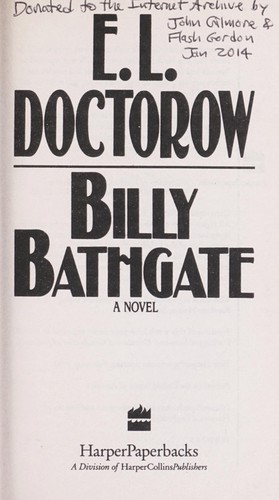
Billy Bathgate
E. L. Doctorow · 1931–2015 · United States
Why it matters
A Bronx teenager apprentices himself to gangster Dutch Schultz's crew just as the empire begins to collapse. Doctorow's Prohibition-era bildungsroman, narrated by a boy learning exactly how far he'll go to belong.
At a glance
A single confident first-person voice carries a fast, violent plot.
Deep dive
What Billy actually learns about arithmetic from watching Dutch Schultz's crew work, and how a teenage juggling act turns into an apprenticeship in exactly the kind of attention that keeps you alive around men this dangerous over mistakes this small.
Written for readers who have finished the book. No plot recap, and nothing here is safe to read first.
Themes & symbolism
Doctorow narrates the whole novel in the voice of Billy Bathgate looking back from adulthood, a Bronx kid whose recruitment into Dutch Schultz's crew begins with literally juggling in the street, a skill the gang reads correctly as the sign of someone with unusual control and nerve. Billy's real education isn't in violence itself but in the numbers underneath it, the bookkeeping, the odds, the precise accounting Schultz's whole operation depends on, and Doctorow makes Billy's gift for mathematics the connective tissue between the small-time street hustler he starts as and the man capable, later, of decoding a dying gangster's delirious final ravings into a literal fortune.
Billy witnesses Bo Weinberg, a lieutenant who has fallen out of favor, bound and dropped alive into the East River wearing concrete overshoes, an initiation into violence Doctorow stages with total procedural calm, the crew discussing logistics the way they'd discuss any other job. Billy's fascination with Drew Preston, Schultz's cultured mistress who is slumming with the gang out of some restless appetite of her own, gives the novel its other axis, a boy testing how far up in the world his new proximity to power can actually take him, against a woman who was born into that world and finds gangsters more honest than the society she left.
The Trial as Its Own Kind of Performance
Schultz's federal tax evasion trial, moved to sympathetic upstate Onondaga County on a change of venue, becomes an exercise in stagecraft as elaborate as any heist: the gang buys goodwill by having Schultz attend church, donate to charity, and charm the local jury pool in the weeks before the verdict. Doctorow treats the acquittal that follows as the novel's darkest joke, the law outmaneuvered not by force but by the same theatrical instincts Billy has been apprenticing in all along, a lesson in performance the boy absorbs as thoroughly as he absorbs the bookkeeping.
The last seal: what actually happens, and why it lands the way it does.
The ending, explained
Schultz and most of his remaining crew are gunned down by hitmen from the national crime syndicate at Newark's Palace Chop House, having become too erratic and too much of a liability, in an assassination Doctorow narrates through Billy's secondhand knowledge rather than as an eyewitness scene. Schultz survives the shooting for hours in a hospital bed, pouring out a famous, genuinely delirious stream of coded language that the historical record has never fully deciphered, and Billy, who alone has spent months learning to read the numbers and habits underneath Schultz's mind, is the one person positioned to extract real meaning, and a hidden fortune, from the ravings. He retrieves the money and effectively vanishes from the gangster world into the adulthood the narration has been speaking from all along, arithmetic turning out to be the one skill violence never managed to make obsolete.
Where to go next
 E. L. Doctorow · 1975RagtimeLvl 6Fast paced
 E. L. Doctorow · 1985World's FairLvl 3Medium pace
 Susan Sontag · 2000In AmericaLvl 6Slow burn
 William T. Vollmann · 2005Europe CentralLvl 9Slow burn
 Thomas Pynchon · 1966The Crying of Lot 49Lvl 8Medium pace
 Steven Millhauser · 1996Martin Dressler: The Tale of an American DreamerLvl 5Medium pace