
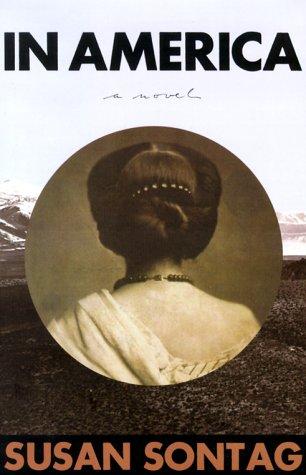
In America
Susan Sontag · 1933–2004 · United States
Why it matters
A celebrated Polish actress emigrates to found a utopian farming commune in California before returning, disillusioned, to the stage that made her famous, narrated with the same essayistic digressions as Sontag's criticism. Her National Book Award winner closed a career built on genre-dissolving intelligence.
At a glance
Essayistic digressions and a shifting narrative voice interrupt the historical plot's momentum deliberately.
Deep dive
Why Susan Sontag sends a celebrated Polish actress and her whole household across an ocean to found a utopian farm colony in Anaheim, then lets the real drama begin only once that commune has already failed.
Written for readers who have finished the book. No plot recap, and nothing here is safe to read first.
Themes & symbolism
Sontag builds the novel around Maryna Zalezowska, a celebrated actress modeled closely on the real nineteenth-century Polish star Helena Modjeska, who abandons a successful career in Warsaw's theater in 1876 to lead a small circle of friends and family, including her husband Bogdan and the young writer Ryszard, a lightly fictionalized Henryk Sienkiewicz, later Poland's Nobel laureate, to found a Fourierist-influenced commune in Anaheim, California, convinced that farming and communal simplicity offer a truer life than the stage ever could. The commune collapses within a year, undone by naive planning and a climate none of them understand, and Sontag treats that failure not as tragedy but as the hinge the whole novel turns on: Maryna's reinvention only really begins once her first, purer American fantasy has already been discarded.
Freed from the commune and from her old Polish stage name, Maryna teaches herself English and rebuilds an acting career from nothing across small American theaters, and Sontag uses that climb, ruthless self-invention through Shakespeare, through relentless touring, through a new stage name built for American audiences, to argue that America's real national religion isn't liberty so much as the sanctioned right to discard an old self entirely and author a new one, a subject close to Sontag's own lifelong interest in celebrity, performance, and self-fashioning as forms of art in their own right.
A Novelist Interrupting Her Own Novel
Sontag begins the book with an unnamed contemporary narrator, unmistakably Sontag herself, eavesdropping on a nineteenth-century dinner party she has no business attending, and returns periodically throughout to break the historical illusion with first-person commentary on why she's telling this particular story this particular way. The device keeps the novel from settling into straightforward historical fiction, insisting instead that Maryna's story is being actively constructed, chosen, and interpreted by a writer working more than a century later, which mirrors exactly what the novel argues Maryna herself is doing to her own biography.
Edwin Booth's Chapter
One full chapter hands the narration entirely to Edwin Booth, the real, celebrated American Shakespearean actor and brother of Lincoln's assassin, delivered as a single unbroken monologue reflecting on Maryna, on acting, and on his own family's unshakeable, inherited notoriety. Sontag uses Booth's chapter to widen the novel's argument about performed identity past Maryna alone, into an entire American theatrical culture built, top to bottom, on people convincing audiences and themselves that a chosen self can outweigh an inherited one.
The last seal: what actually happens, and why it lands the way it does.
The ending, explained
By the novel's final sections, Maryna has become one of the most celebrated actresses on the American stage, touring in Shakespeare's great roles to acclaim that Poland, for all her fame there, never quite matched, and Sontag lets that success sit uneasily rather than triumphantly: the achievement is real, but it's built on a name, a language, and a life invented from scratch to replace one she gave up by choice, and the novel's closing pages let Maryna herself wonder, in quieter moments than her public performances ever allow, what exactly of the original Warsaw actress survived the whole American transformation intact. Sontag declines to answer the question directly, ending instead on Maryna mid-performance, fully inhabiting the invented American self one more time, which the novel treats as the closest thing to an honest answer available: identity, for Sontag's Maryna, was never a fixed thing to lose or preserve, only ever the next role convincingly worn.
Where to go next
 E. L. Doctorow · 1975RagtimeLvl 6Fast paced
 Donald Barthelme · 1981Sixty StoriesLvl 6Medium pace
 William T. Vollmann · 2005Europe CentralLvl 9Slow burn
 Thomas Pynchon · 1966The Crying of Lot 49Lvl 8Medium pace
 Sigrid Nunez · 2018The FriendLvl 4Slow burn
 Lily Tuck · 2004The News from ParaguayLvl 6Medium pace