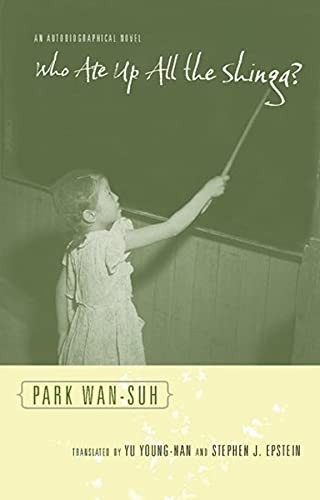
Who Ate Up All the Shinga?
Park Wan-suh · 1931–2011 · South Korea
Originally Geu Manteon Singaneun Nuga Da Meogeosseulkka (Korean) · translated by Yu Young-nan and Stephen J. Epstein
Why it matters
Park recalls her own girlhood through the Korean War's devastation and the hollow promises of the wealth that followed. Modern Korea's essential autobiographical reckoning with a century of trauma.
At a glance
Clear memoir-style narration, occasionally dense with specific historical detail.
Deep dive
What a half-forgotten wild plant from a vanished hometown has to do with surviving a war, and why Park waited decades to write it down.
Written for readers who have finished the book. No plot recap, and nothing here is safe to read first.
Themes & symbolism
The shinga of the title — a sour wild plant children foraged and ate in the countryside around Park's childhood home near Kaesong — stands in for an entire prewar way of life that the novel treats as both real and already half-mythologized by the act of remembering it: an idyll of rural abundance and childish unselfconsciousness that the Korean War, and everything that follows it, makes permanently unreachable. That unreachability isn't only emotional. Kaesong ended up on the North Korean side of the postwar border, meaning the literal ground of Park's childhood became a place she could describe but never again visit, which gives the memoir's nostalgia an edge sharper than ordinary wistfulness — she isn't just recalling a lost time, she's recalling a lost place that a national partition sealed off from her permanently.
The book's real subject is the wreckage the war leaves inside a family that thought of itself as a cut above its circumstances: Park's mother clings fiercely to status and propriety — insisting on a prestigious Seoul education for her daughter, policing appearances — even as the family is reduced to refugee poverty, and that gap between maintained pride and actual dislocation becomes the memoir's central irony. Loss threads through the book not as a single dramatic event but as accumulation: displacement, the war's disruption of ordinary family structure, and a pervasive survivor's guilt at having endured what others close to her did not, recounted in a flat, unsentimental register that refuses the reader an easy catharsis for any of it.
Autobiography as Delayed Testimony
Park didn't begin publishing fiction until her forties, decades after the war she writes about here, and the memoir carries the particular weight of testimony that had to wait — trauma processed only once enough distance made it narratable at all. That delay shapes the book's tone: it isn't raw in the way of writing produced close to an event, but neither has time smoothed it into anything like resolution: the prose reads like someone finally setting down a story she'd been carrying, unspoken, for most of a lifetime.
A War Story Told from the Kitchen, Not the Front
Korean War literature in the decades after 1953 skewed heavily toward male, front-line narration — soldiers, ideology, battle. Park's memoir works the same historical catastrophe from inside a household of women and children absorbing its aftershocks: rationing, displacement, the scramble to maintain a family's dignity with almost nothing to maintain it with. That domestic vantage point was, and remains, a genuinely underrepresented angle on the war in Korean letters, part of why the book is treated less as a personal memoir than as a necessary national document.