
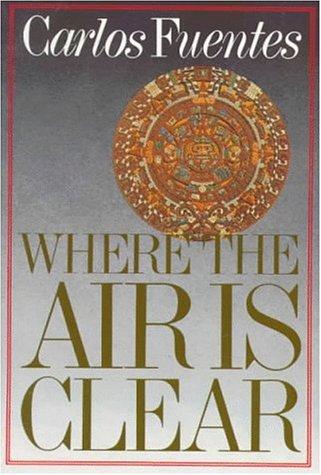
Where the Air Is Clear
Carlos Fuentes · 1928–2012 · Mexico
Originally La región más transparente (Spanish) · translated by Sam Hileman
Why it matters
A panoramic cross-section of Mexico City, aristocrats, revolutionaries-turned-financiers, servants, and the mysterious Ixca Cienfuegos binding them, tracks how the Revolution's promises curdled into a new elite. Fuentes's sprawling debut announced Mexico's new novel.
At a glance
A vast ensemble cast and fractured, multi-voiced structure resist any single throughline.
Deep dive
Why Fuentes gives a mystical, ambiguous narrator the job of stitching together Mexico City's revolutionaries turned financiers, and what pre-Columbian force he seems to be channeling underneath the modern capital.
Written for readers who have finished the book. No plot recap, and nothing here is safe to read first.
Themes & symbolism
Ixca Cienfuegos moves through nearly every strand of Where the Air Is Clear's sprawling Mexico City cast, aristocrats, financiers, artists, servants, prostitutes, without ever quite functioning as a conventional character himself, and Fuentes eventually makes explicit what the novel has been implying all along: Ixca is bound up with Huitzilopochtli, the Aztec god of war and sun, an ancient, indigenous consciousness persisting underneath the modern capital's steel and concrete, watching the city's new elite congratulate itself on having escaped its own history. His conversations with other characters function less as dialogue than as a kind of interrogation the pre-Columbian past is conducting on the postrevolutionary present.
Federico Robles, who rose from genuine peasant poverty through the Revolution into a banking fortune, is the novel's central case study in what that escape from history actually costs. His marriage to the vain, status-obsessed Norma Larragoiti curdles into mutual contempt, and his accumulated wealth buys him respectability without ever converting into anything he recognizes as satisfaction. Fuentes uses Robles's rise to indict the Revolution's own outcome: a generation that fought to redistribute power in Mexico produced, one generation later, a financial aristocracy nearly indistinguishable from the one it replaced.
Rodrigo Pola, a failed poet who eventually sells out into commercial screenwriting, gives Fuentes his second case study in the same corruption, run through art rather than finance. Where Robles built a fortune on top of buried peasant origins he'd rather forget, Rodrigo builds a screenwriting career on top of buried literary ambitions he can no longer take seriously, and Fuentes treats the two men's parallel compromises as evidence that the postrevolutionary bargain, trade your original convictions for security, corrupted Mexico City's cultural class exactly as thoroughly as it corrupted its financiers.
Retroceso: Fuentes's Flashback Machine
Fuentes builds the novel's structure around retroceso, a technique of dropping backward into a character's earlier life mid-scene without warning or transition, so that Robles's peasant childhood, his combat years, and his banking present all sit layered on top of each other rather than arranged in sequence. That refusal of chronological order isn't just a modernist flourish borrowed from Faulkner and Dos Passos, both clear influences, it's argument by form: Mexico City's present, the novel keeps insisting, cannot actually be understood without its past intruding on it constantly, uninvited, mid-sentence, exactly the way retroceso intrudes on the reading experience itself.
The last seal: what actually happens, and why it lands the way it does.
The ending, explained
Robles's financial empire collapses under exposed fraud around the same time his marriage disintegrates. Norma dies in a fire during their final, vicious confrontation, and Fuentes leaves Robles stripped of the fortune, status, and self-mythology he spent the entire postrevolutionary period building. Ixca, meanwhile, never resolves into anything more concrete than he already was, an ambiguous, possibly supernatural presence whose real function was always to make the city's characters confront a continuity, Aztec, colonial, revolutionary, financial, that Robles's generation had convinced itself it could simply outrun. The novel closes without offering Robles or the reader any redemption for that conviction, only the wreckage of having briefly believed the past could be spent down like capital.
Where to go next
 Carlos Fuentes · 1962The Death of Artemio CruzLvl 8Slow burn
 Carlos Fuentes · 1962AuraLvl 6Medium pace
 Carlos Fuentes · 1975Terra NostraLvl 10Slow burn
 Carlos Fuentes · 1985The Old GringoLvl 5Medium pace
 Mario Vargas Llosa · 1963The Time of the HeroLvl 6Medium pace
 Gabriel García Márquez · 1967One Hundred Years of SolitudeLvl 6Medium pace