
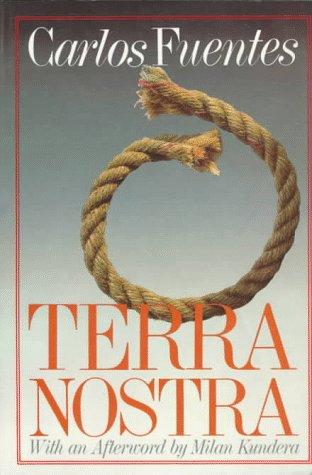
Terra Nostra
Carlos Fuentes · 1928–2012 · Mexico
Originally Terra Nostra (Spanish) · translated by Margaret Sayers Peden
Why it matters
Nine hundred years of Spanish and Latin American history collide in one Madrid palace: Philip II, conquistadors, doubles, and a future already remembered. Fuentes's total novel, and the Boom's most maximalist reckoning with imperial inheritance.
At a glance
A nearly 800-page labyrinth of doubled characters, myth, and looping timelines defies linear reading.
Deep dive
Why Fuentes builds his most ambitious novel out of doubles, reincarnations, and a calendar that keeps folding back on itself instead of moving forward.
Written for readers who have finished the book. No plot recap, and nothing here is safe to read first.
Themes & symbolism
Terra Nostra's method is repetition as argument: the same figures recur across nine centuries — a wandering Pilgrim reborn generation after generation, doubled and tripled versions of Philip II presiding over an Escorial built as much to entomb the future as to honor the past, echoes of Don Juan and Don Quixote's restless appetite for a world that keeps refusing to match their imagination of it. Fuentes isn't proposing reincarnation as mysticism so much as using it structurally, to argue that Spain and its American colonies never actually had a linear history at all — only the same founding traumas (conquest, purity obsession, absolutism, syncretic violence against indigenous belief) replaying themselves in new costume, generation after generation, with the New World forced to inherit and repeat wounds it never chose.
The novel's obsession with sixes — six toes, six fingers, characters born with a sixth digit as a mark of otherness and excess — recurs as a signature of everything the official, purity-obsessed culture of Philip's Spain tries to amputate or burn out of itself: Jewish and Moorish blood, indigenous belief, bodily and sexual heterodoxy, historical memory itself. Every attempt within the novel to impose a single, closed, orthodox story on this hybrid reality — the Inquisition's fires, Philip's obsessive sealing of his own dynastic bloodline — generates exactly the excess and doubling it was trying to eliminate, which is Fuentes's larger claim about Latin American identity: it is irreducibly plural, and every imperial project to make it singular only multiplies it further.
The Boom's Most Maximalist Novel
Where García Márquez compresses a continent's history into one family's hundred years and Vargas Llosa works through realist institutional detail, Fuentes goes the opposite direction entirely: nine hundred pages, a cast of doubled and reincarnated characters spanning from the fall of Rome through the Reconquista and conquest of the Americas into a science-fictional near-future Paris, told through shifting narrators, second-person address, and prose that borrows equally from chronicle, myth, and pornography. It's the novel most often cited as the Boom's outer limit of ambition — critics have called it unreadable and unmatched in the same breath — because Fuentes is attempting something none of his contemporaries tried: not a single culture's myth (Macondo, Comala) but the entire nine-century inheritance of the Hispanic world, imperial Spain and colonized America treated as one continuous, traumatized organism.
The last seal: what actually happens, and why it lands the way it does.
The ending, explained
Terra Nostra doesn't build toward a resolution because its entire argument is that Hispanic history isn't a line that resolves — it's a closed loop. The novel's contemporary frame converges on Paris as the year 1999 approaches (itself a 'future' invented from Fuentes's 1975 vantage point), where the doubled Pilgrims, the ghosts of Philip's Escorial, and the accumulated violence of nine centuries all collapse into one another rather than into a single climactic event. Characters who seemed distinct across centuries turn out to be the same soul recurring; the linear clock the novel has nominally been counting down gives way to a cyclical one, in which conquest, inquisition, and utopian hope all replay indefinitely rather than progressing toward anything. Fuentes ends the book on that refusal deliberately: a tidy climax would concede that Spanish and Latin American history is progressing somewhere, when his entire nine-hundred-page case is that it's a wheel, not an arrow — apocalypse and renewal arriving as the same event, because in Fuentes's Terra Nostra they always are.
Where to go next
 Carlos Fuentes · 1958Where the Air Is ClearLvl 8Slow burn
 Carlos Fuentes · 1962The Death of Artemio CruzLvl 8Slow burn
 Carlos Fuentes · 1962AuraLvl 6Medium pace
 Carlos Fuentes · 1985The Old GringoLvl 5Medium pace
 Mario Vargas Llosa · 1963The Time of the HeroLvl 6Medium pace
 Gabriel García Márquez · 1967One Hundred Years of SolitudeLvl 6Medium pace