
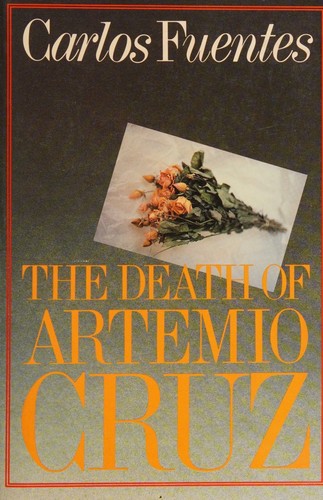
The Death of Artemio Cruz
Carlos Fuentes · 1928–2012 · Mexico
Originally La muerte de Artemio Cruz (Spanish)
Why it matters
A dying oligarch remembers in first, second, and third person: the Mexican Revolution's betrayal conjugated across one deathbed. The Boom's technical manifesto and Mexico's great novel of power.
At a glance
Shifting first-, second-, and third-person narration deliberately scrambles chronology.
Deep dive
Three grammatical persons narrate one dying man's life — and the novel's real suspense is over which one of them is lying to him.
Written for readers who have finished the book. No plot recap, and nothing here is safe to read first.
Themes & symbolism
Fuentes splits Cruz into three grammatical persons that don't just vary perspective but perform a theory of selfhood: the first-person 'I' is Cruz's own disintegrating present-tense consciousness, unreliable and self-serving even on his deathbed; the third-person 'he' supplies the ostensibly objective historical record of the choices that made him rich and untouchable; and the second-person 'you' is neither — an uncanny, almost prophetic voice that seems to know Cruz's fate before he does and addresses him with an intimacy his own first-person voice can't achieve, as though conscience had to be exiled from the 'I' to speak the truth at all.
The novel's real subject is the Mexican Revolution's conversion into its opposite: Cruz begins with real revolutionary conviction and ends as exactly the kind of landed, corrupt power broker the Revolution was fought to eliminate, and Fuentes is explicit that Cruz is one case among many — an entire postrevolutionary elite that inherited the old Porfiriato's privileges under new revolutionary credentials. His son Lorenzo's death fighting for the Spanish Republic reads as the ghost of the idealism Cruz sold off, resurfacing a generation later in a fight Cruz himself no longer has the moral standing to have joined. Catalina and his long-term mistress occupy the same structural position in his life: both are acquired the way he acquires land and newspapers, valued for what they secure rather than for themselves, and both register that fact long before Cruz's dying mind is forced to.
Three Voices, One Man
The 'you' sections are the novel's most radical formal choice, since sustained second-person narration in Spanish-language fiction was still a genuine novelty in 1962: by having a voice outside Cruz's own 'I' articulate what Cruz can't admit to himself — his cowardice in a specific wartime betrayal, his calculated marriage into the Catalina family's fading fortune, his transactional treatment of everyone he claims to love — Fuentes makes guilt structurally inescapable rather than a matter of Cruz's own unreliable self-report. The technique lets the novel try Cruz in a court his own consciousness can't rig, since the prosecuting voice is grammatically inseparable from the man it's prosecuting.
The Revolution's Ledger
Each third-person chapter functions as a dated ledger entry in the Revolution's slow corruption, moving from Cruz's poor mixed-race origins and battlefield opportunism through his acquisition of land, a newspaper, and political influence, charting exactly how revolutionary capital converts into old-fashioned oligarchic wealth. Fuentes wrote the novel as a direct indictment of the one-party PRI state he saw perpetuating this exact conversion in real time, using Cruz's biography as Mexico's own disguised one. The chapters aren't arranged chronologically but by a logic of association with Cruz's present-tense dying thoughts, so the reader assembles the historical indictment in fragments, the way Cruz's own guilt surfaces — sideways, and only under duress.
The last seal: what actually happens, and why it lands the way it does.
The ending, explained
As Cruz's body fails — the present-tense 'I' chapters tracking surgery, catheters, and organ failure with clinical, disintegrating precision — the novel's three voices begin to blur into each other, formally enacting the dissolution of a self that spent a lifetime keeping its worst compromises safely partitioned. The final 'you' address delivers the full accounting of his betrayals without granting absolution or a deathbed conversion; Cruz dies exactly as corrupt as he lived, his fortune intact and passing to heirs who will keep the same system running. The Revolution's betrayal doesn't end with him — it simply continues, unredeemed by his death, into the next generation.
Where to go next
 Carlos Fuentes · 1958Where the Air Is ClearLvl 8Slow burn
 Carlos Fuentes · 1962AuraLvl 6Medium pace
 Carlos Fuentes · 1975Terra NostraLvl 10Slow burn
 Carlos Fuentes · 1985The Old GringoLvl 5Medium pace
 Mario Vargas Llosa · 1963The Time of the HeroLvl 6Medium pace
 Gabriel García Márquez · 1967One Hundred Years of SolitudeLvl 6Medium pace