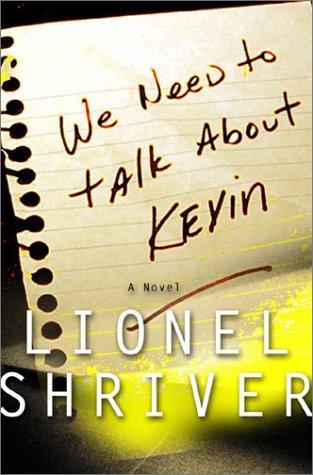
We Need to Talk About Kevin
Lionel Shriver · b. 1957 · United States
Why it matters
A mother writes to her estranged husband, reconstructing their son's unsettling childhood after he commits a school massacre. A chilling, self-interrogating epistolary novel that never quite lets its narrator, or the reader, settle the question of blame.
At a glance
An unreliable, self-justifying narrator demands close attention to what she isn't quite saying.
Deep dive
A mother writes letter after letter to her estranged husband trying to explain their son, and Lionel Shriver builds the entire novel out of the gap between what Eva knew about Kevin all along and what she let herself say out loud.
Written for readers who have finished the book. No plot recap, and nothing here is safe to read first.
Themes & symbolism
Eva Khatchadourian narrates the whole novel as a series of letters to her husband Franklin, composed after their son Kevin, at fifteen, attacks his high school with a crossbow. Shriver builds suspense less around the massacre itself, which the reader knows about from the opening pages, than around Eva's own culpability: whether her ambivalence about motherhood, her instinct from Kevin's infancy that something in him resisted her, actually shaped the person he became, or whether she is simply the one person willing to admit, retroactively, to having noticed.
Franklin functions throughout as Eva's opposite number, a father determined to see an ordinary, perhaps difficult boy where Eva insists she sees something colder, and Shriver uses that marital disagreement to interrogate how thoroughly American culture assigns emotional labor, and blame, to mothers specifically. Kevin's sister Celia, gentle and vulnerable in exactly the ways Kevin isn't, becomes the test case for Eva's theory: Kevin's cruelty toward Celia, small and escalating, reads to Eva as confirmation of something essential in him that Franklin refuses to see, right up until the novel's own devastating correction of what Eva has been protecting Franklin from learning.
The Letters as an Unreliable Confession
Eva's own account is shot through with retrospective bias she rarely acknowledges as bias, she is building a case, consciously or not, for both her own innocence and her own guilt simultaneously, sometimes in the same letter. Shriver never resolves whether Eva's cold instincts about Kevin were maternal insight or self-fulfilling prophecy, and the ambiguity is the novel's engine: nature versus nurture staged not as an argument to be settled but as a wound Eva keeps reopening in her own writing.
Kevin as a Void the Novel Refuses to Fill
Shriver keeps Kevin's own interiority almost entirely opaque, filtered exclusively through Eva's interpretation of his silences, his contempt, his calculated cruelty, so that the reader is left in precisely Eva's position: unable to determine whether Kevin is a genuinely malevolent presence or a boy Eva decided, early and irrevocably, to see that way.
The last seal: what actually happens, and why it lands the way it does.
The ending, explained
The letters gradually reveal what Eva has been withholding even from her own narration: on the same morning Kevin attacked his school, he had already used the same crossbow to attack Franklin and Celia at home, arranging the scene for Eva to find later. Franklin and Celia's total absence from every present-day scene in the novel, which the reader has simply accepted without question, turns out to be the book's structural trick, their fate was never mentioned because Eva could not bring herself to narrate it directly until the end. In the novel's final scene, visiting Kevin in the facility holding him as he approaches adulthood, Eva asks him why he did it, and Kevin, for the first time, admits he no longer knows himself. Eva closes her account resolving to keep a room ready for him regardless, an ending that offers no absolution, only the continuation of a bond neither of them can fully explain.