
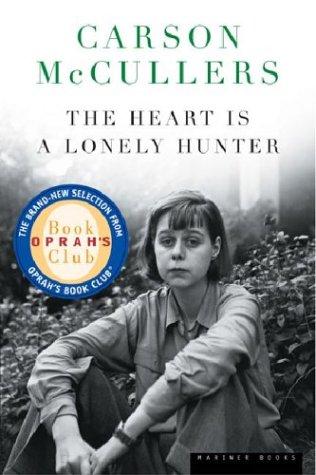
The Heart Is a Lonely Hunter
Carson McCullers · 1917–1967 · United States
Why it matters
A deaf-mute becomes the confessor for a mill town's lonely misfits, each pouring longing into a man who cannot answer. McCullers wrote this study of isolation at twenty-three: the Southern Gothic at its most tender.
At a glance
Multiple interwoven character strands require patience despite the plain style.
Deep dive
A deaf-mute man becomes the silent confessor for a mill town's loneliest people, each one certain he understands them — McCullers's aching study of what we project onto listeners who never actually answer.
Written for readers who have finished the book. No plot recap, and nothing here is safe to read first.
Themes & symbolism
Singer's muteness is a mirror the whole town mistakes for a window: Mick, Biff, Jake, and Dr. Copeland each visit him convinced he shares their politics, their sensibility, their sense of the world's injustice, when in fact his attentive stillness is simply blank enough to receive whatever they need it to hold. McCullers structures the novel almost musically, in movements that circle among the four confessors, and the irony compounds with each visit: Jake's inchoate labor radicalism, Dr. Copeland's exhausted dignity and racial idealism, Mick's hunger for music and a bigger life, Biff's watchful, ambiguous tenderness — none of these people ever actually talk to each other, only past each other, at Singer, who understands almost none of it and cares even less, his real attention entirely consumed elsewhere.
That elsewhere is Antonapoulos, the intellectually disabled fellow deaf-mute Singer loves without any hope of it being received in kind — Singer writes him long, searching letters full of thoughts he shares with no one else in the book, letters Antonapoulos is incapable of even really reading. The novel's structural cruelty is that its listener figure is himself a devoted, unheard speaker, so that loneliness in this book isn't a deficiency some characters have and others don't, it's the total condition everyone shares, arranged in a chain where each person's silence gets misread by the next as understanding. McCullers, writing this at twenty-three, gives the mill town's poverty and Depression-era stagnation their own symbolic charge too — everyone here is reaching for a way out (music, politics, medicine, observation itself) that the town's economic deadness makes structurally unreachable.
Mick Kelly and the Autobiographical Core
Mick, thirteen when the novel opens, is McCullers's clearest self-portrait: a poor, gawky, music-obsessed girl who builds a private inner world (she calls it her "inside room") out of borrowed classical records and half-understood ambition, certain she's destined for something larger than the mill town allows. Her arc across the novel — from that private, expansive interior life toward the diminished reality of factory work she takes to help her family survive — tracks McCullers's own anxieties about art, class, and escape, and gives the novel's abstract theme of thwarted longing its most concrete, devastating shape. Biff's puzzled, half-parental fascination with Mick as she ages into adolescence is one of the novel's more unsettling notes, McCullers declining to resolve or fully name what she's depicting.
The last seal: what actually happens, and why it lands the way it does.
The ending, explained
Antonapoulos's death in the asylum removes the one relationship Singer's entire inner life had been organized around, and Singer responds by shooting himself, an act the novel refuses to sentimentalize or fully explain — it simply registers as the collapse of the only bond that had made his silence bearable to him. His death leaves Mick, Biff, Jake, and Dr. Copeland each suddenly unmoored, forced to recognize that the understanding they'd each privately believed Singer held for them was never really there, only their own need reflected back. McCullers denies all four any real consolation afterward: Mick is settling into factory labor instead of music, Jake drifts toward another town and another failed cause, Dr. Copeland's health and political hopes are both failing, Biff is left alone in his café with a longing he can't name. The final image is deliberately anticlimactic — ordinary town life resuming, indifferent to the losses just absorbed.
Where to go next
 Carson McCullers · 1946The Member of the WeddingLvl 5Slow burn
 Cormac McCarthy · 1992All the Pretty HorsesLvl 6Medium pace
 Eudora Welty · 1972The Optimist's DaughterLvl 4Medium pace
 Flannery O'Connor · 1955A Good Man Is Hard to FindLvl 5Fast paced
 John Kennedy Toole · 1980A Confederacy of DuncesLvl 4Fast paced
 Toni Morrison · 1987BelovedLvl 8Slow burn