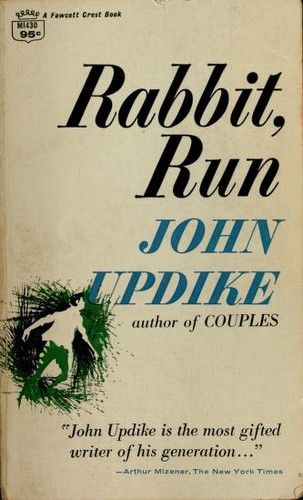
Rabbit, Run
John Updike · 1932–2009 · United States
Why it matters
A former high-school basketball star flees his marriage and job, chasing a grace he can't name. The first of Updike's four Rabbit novels: middle-class American manhood examined in shimmering prose.
At a glance
Present-tense, sensorily dense prose slows a deceptively ordinary plot.
Deep dive
What Rabbit means by "grace" — the feeling he's chasing every time he takes off — and why pursuing it always looks, from everyone else's side of the door, exactly like abandonment.
Written for readers who have finished the book. No plot recap, and nothing here is safe to read first.
Themes & symbolism
Rabbit Angstrom peaked at eighteen, a high school basketball star whose one unambiguous experience of being first-rate at something recasts his entire adult present — a mediocre sales job demonstrating a kitchen gadget, a marriage to a woman he finds dull, a house he finds airless — as permanent anticlimax. His repeated flights aren't rebellion so much as a search for that same feeling under a name he's borrowed from church: grace. Updike stages the word's secularization explicitly through two competing clergymen — Reverend Eccles, golf-playing, therapeutic, more interested in managing Rabbit's feelings than in doctrine, and the dour, old-school Reverend Kruppenbach, who still believes in sin and tells Eccles so. Between them the novel suggests that mid-century suburban Christianity has nothing left to offer someone chasing transcendence, so Rabbit goes looking for it in his own body instead — in sex, in driving south with no destination, in the pure improvisational instinct he once had on a basketball court and can't locate anywhere else.
The women in Rabbit's orbit exist largely as terrain he crosses on the way to himself: Janice, pregnant and drinking, trapped in a domestic claustrophobia the novel renders with real cruelty toward her interior life; Ruth, an ex-prostitute whose body and apartment become a refuge Rabbit treats as owed to him. Updike's prose lavishes gorgeous, specific attention on Rabbit's every sensation while rarely extending the same interiority to the women whose lives absorb the damage of his leaving — a structure later critics, and eventually Updike himself across the three Rabbit novels that followed, acknowledged as morally troubling even as it's rendered with total conviction.
Present Tense and the Grammar of Impulse
Updike's choice to write the novel in present tense was unusual for serious literary fiction in 1960, and it's doing real thematic work: it keeps the reader locked in Rabbit's immediate sensory now exactly as he's locked in it himself, unable to draw a lesson from what just happened or plan more than a few pages ahead. The prose moves the way Rabbit's old basketball game moved — pure reflex and improvisation, gorgeous in the instant, accountable to nothing beyond it — which makes the style itself an argument: Rabbit isn't a philosopher failing to reason his way to a better life, he's an athlete's nervous system trying to run a domestic life on instinct, and the present tense won't let the reader forget it.
The last seal: what actually happens, and why it lands the way it does.
The ending, explained
After Rabbit leaves Janice again for Ruth, Janice, drunk and alone with their infant daughter Rebecca, accidentally drowns the baby while bathing her in a moment of despair. Rabbit returns for the funeral and, confronted by the Springers' grief and blame, blurts out that he didn't kill her — technically true, and catastrophically the wrong thing to say at a graveside, which turns the room against him completely. Rather than stay to face what he's caused, he runs again, literally, straight from the funeral to Ruth, who tells him she's pregnant and that she'll have an abortion unless he commits to her for good. Rabbit can't decide — the same paralysis that's driven every flight in the book — and instead of choosing, he goes out for a walk that turns into another aimless run down the street, the novel's famous last lines dissolving into fragments of pure motion: "he runs. Ah: runs. Runs." Updike denies the reader any catharsis or verdict on purpose — Rabbit doesn't learn, doesn't choose, doesn't stop, and the sentence itself refuses to resolve into a completed action, leaving him suspended mid-flight exactly where his whole character has always lived.