
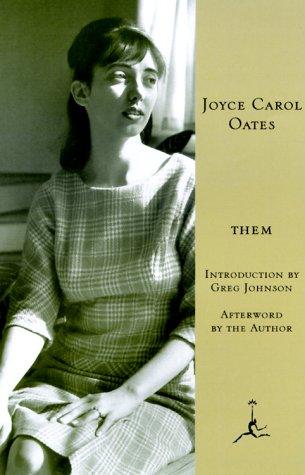
them
Joyce Carol Oates · b. 1938 · United States
Why it matters
A Detroit family scrapes through poverty, violence, and the 1967 riots across three decades, based partly on the real life of one of Oates's students. A blistering, unsentimental epic that won her the National Book Award at thirty-one.
At a glance
Dense, feverish prose tracks a Detroit family across two violent decades.
Deep dive
Why Oates keeps interrupting her own novel to argue with it, and what Maureen's flat, unhappy ending says about the American dream of getting out.
Written for readers who have finished the book. No plot recap, and nothing here is safe to read first.
Themes & symbolism
Oates based the Wendall family's decades of Detroit poverty partly on a real former student's letters, and the novel keeps reminding you of that origin — an author's note frames the whole book as reportage Oates felt unqualified to fully invent, and a metafictional 'Oates' periodically intrudes as narrator, unsettled by her own inability to impose novelistic shape on a life this genuinely chaotic. That friction is as much the book's real subject as the Wendalls' violence and poverty: whether literature can honestly represent lives that resist narrative order, or whether novelizing poverty is itself a kind of theft.
Loretta, Jules, and Maureen each chase a version of the American promise the novel systematically denies them — Loretta through men and remarriage, Jules through crime and reinvention, Maureen through sheer bodily withdrawal, going catatonic for the better part of a year after a violent, degrading encounter, then clawing back toward stability through the most conventional means imaginable, marriage to a professor. The 1967 Detroit riots arrive two-thirds through as historical eruption rather than climax, engulfing the family's world without redeeming or explaining it, Oates's blunt insistence that this violence doesn't resolve into meaning just because a novel is watching it happen.
Jules's arc, running from petty hustling to an affair with a wealthy, unstable woman to eventual involvement with radical politics, tracks the same energy that makes Loretta and Maureen's stories so grim — a hunger for reinvention that the city keeps punishing rather than rewarding — but Oates lets him survive on charm and luck in a way she denies the women, a quiet observation about whose recklessness gets treated as vitality and whose gets treated as ruin. Detroit itself, decaying and combusting across the decades the novel covers, functions less as backdrop than as a third parent, shaping the family's fates as decisively as any relative does.
them and the Woman Behind Maureen
Oates taught a student, referred to in interviews and the novel's own note as the real-life basis for Maureen, whose letters describing her family's Detroit hardships supplied much of the book's raw material; Oates has described feeling implicated by turning a living person's suffering into fiction, a discomfort the novel dramatizes directly rather than smoothing over. That unease is why the title works: the family are objects of documentary curiosity to the narrator even as she insists on their full subjectivity, a contradiction the book never fully resolves.
Naturalism Without Consolation
Oates, thirty-one when she won the National Book Award for this novel, writes squarely in the American naturalist tradition of Dreiser and Farrell — characters shaped by economic and urban forces largely beyond their control — but refuses that tradition's usual consolations of tragic grandeur. The prose stays flat and unsentimental through beatings, riots, and breakdowns alike, denying the reader the catharsis a more conventionally 'literary' treatment of the same material would supply.
The last seal: what actually happens, and why it lands the way it does.
The ending, explained
Maureen's yearlong catatonic withdrawal, following abuse at the hands of her stepfather and a subsequent violent episode, ends not in tragedy but in a muted, almost bureaucratic recovery: she resumes her life and eventually marries a professor, achieving exactly the respectable stability the rest of the novel has shown to be nearly unreachable for people in her circumstances. Oates plays this as ironic rather than triumphant — a flat, undramatic 'happy ending' arriving almost accidentally, disconnected from any of the striving that has driven the book's violence. The metafictional Oates-narrator closes by admitting discomfort with shaping real suffering into a novel at all, refusing the reader's expectation that a decade of documented chaos should add up to a tidy moral.
Where to go next
 William Faulkner · 1930As I Lay DyingLvl 9Medium pace
 Toni Morrison · 1987BelovedLvl 8Slow burn
 Cormac McCarthy · 1992All the Pretty HorsesLvl 6Medium pace
 António Lobo Antunes · 1979The Land at the End of the WorldLvl 8Slow burn
 Orhan Pamuk · 1998My Name Is RedLvl 7Medium pace
 Stefan Zweig · 1942Chess StoryLvl 4Fast paced