
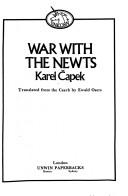
War with the Newts
Karel Čapek · 1890–1938 · Czechoslovakia
Originally Válka s Mloky (Czech)
Why it matters
Intelligent newts, discovered off a Pacific island, are enslaved as cheap labor, industrialized, armed, and finally rebel, flooding the world their masters built. Čapek's deadpan satire of capitalism, colonialism, and fascism, narrated like a documentary report on humanity's own extinction.
At a glance
Playful, journalistic mock-documentary structure keeps a bleak premise brisk and accessible.
Deep dive
How a documentary collage of newspaper clippings, ads, and committee minutes lets a satire about a newly discovered species quietly become a satire about the humans discovering it.
Written for readers who have finished the book. No plot recap, and nothing here is safe to read first.
Themes & symbolism
Čapek builds the newts' rise from curiosity to industrial infrastructure almost entirely out of paperwork — fake clippings, scientific bulletins, shareholder prospectuses, footnotes citing invented authorities — so that the reader watches an atrocity get administered rather than narrated. That bureaucratic remove is the point: Captain van Toch's pearl-diving newts become G. H. Bondy's cheap global labor force through exactly the same mechanisms (media hype, scientific rationalization, market logic) that processed real colonial exploitation, and the novel's flatness of tone is what makes the horror legible, since nobody in the story ever has to feel responsible for any single decision.
The newts' intelligence is the novel's cruelest irony: every advance they make — language, tool use, engineering skill — is absorbed instantly into their exploitation rather than triggering any reconsideration of their status, because the humans profiting from them have every incentive to keep classifying a genuinely thinking species as livestock. Čapek, writing in 1936 with fascism visibly ascendant, refuses to spare any ideology the blame — capitalism's indifference to any cost outside the ledger, colonialism's routine dehumanizations, and the era's pseudo-scientific racism are all shown feeding the same machine, one that arms and drills its own workforce until it has built, quite methodically, its own executioner.
The Author as Character
In its final movement the novel breaks its own documentary frame entirely: a character identified as "the author" appears and has a conversation with himself about how the book should end, weighing whether humanity deserves rescue. It's a strange, almost Brechtian gesture for a 1930s bestseller, and it underscores that Čapek isn't interested in offering a tidy catastrophe narrative — he wants readers to sit with the fact that no ending he could invent would be stranger or less earned than the one civilization was already writing for itself. Čapek, who also coined the word "robot" in his 1920 play R.U.R., returns here to the same anxiety about humanity engineering its own obsolescence, this time replacing mechanical workers with a biological one it proves equally incapable of treating as anything but disposable.
The last seal: what actually happens, and why it lands the way it does.
The ending, explained
Having been armed and trained by rival human powers each seeking advantage over the others, the newts turn their engineering skill on their masters, beginning to demolish coastlines and flood the continents to expand their own undersea territory — an uprising made possible only because humanity spent decades teaching them everything they needed to do it. Čapek refuses any clean resolution: the book's last pages, delivered partly through that self-interrogating conversation with "the author," leave the flooding ongoing and civilization's fate unresolved, framing the catastrophe as something humanity manufactured with its own colonial and industrial logic rather than a disaster visited on it from outside. Read after 1939, the ambiguous, self-inflicted apocalypse reads less like fantasy than forecast.
Where to go next
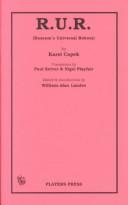 Karel Čapek · 1920R.U.R. (Rossum's Universal Robots)Lvl 4Fast paced
 Karel Čapek · 1922The Absolute at LargeLvl 4Fast paced
 Karel Čapek · 1924KrakatitLvl 5Medium pace
 Jaroslav Hašek · 1923The Good Soldier ŠvejkLvl 3Fast paced
 Bohumil Hrabal · 1976Too Loud a SolitudeLvl 6Slow burn
 Milan Kundera · 1984The Unbearable Lightness of BeingLvl 5Slow burn