
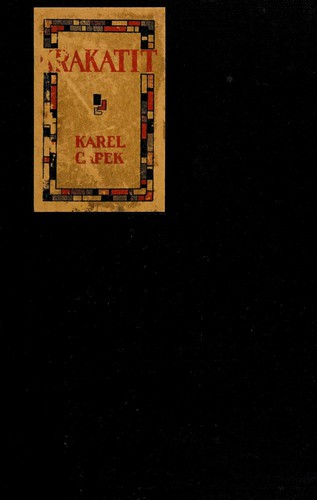
Krakatit
Karel Čapek · 1890–1938 · Czechoslovakia
Originally Krakatit (Czech)
Why it matters
An engineer who has invented an explosive powerful enough to annihilate cities wanders fevered and hunted, pursued by governments and arms dealers eager to weaponize his discovery. Čapek's atomic-age nightmare arrived two decades before the bomb it seems to prophesy.
At a glance
A feverish, hallucinatory chase narrative blurs dream and reality throughout.
Deep dive
A chemist invents an explosive powerful enough to annihilate matter itself, loses control of the formula almost immediately, and spends the rest of the novel discovering just how many people want a weapon like that far more than they want him.
Written for readers who have finished the book. No plot recap, and nothing here is safe to read first.
Themes & symbolism
Engineer Prokop stumbles onto the formula for an explosive of unprecedented power, which he names Krakatit after the Indonesian volcano, capable of breaking apart the atomic structure of anything it touches and triggered remotely by nothing more than a matching wavelength of radio signal. Čapek wrote the novel in 1924, two decades before nuclear weapons existed, and its premise, a discovery so dangerous that simply possessing the knowledge makes its inventor a target for every government and syndicate that learns of it, reads now as one of literature's earliest and most exact anticipations of the moral position atomic scientists would actually find themselves in twenty years later.
After an accidental explosion leaves him injured and delirious, Prokop discovers he gave away the formula to a colleague while feverish and cannot remember doing it, and the novel's back half becomes a paranoid chase across a landscape of financiers, foreign agents, and a princess who wants Krakatit for reasons of her own, each faction convinced that whoever controls the explosive controls the balance of power in Europe. Čapek keeps Prokop's own physical and mental state, feverish, injured, alternately lucid and hallucinating, inseparable from the novel's larger argument: a discovery this dangerous was never going to be handled rationally, by its inventor least of all, and the political machinery converging on him operates with exactly the same feverish, half-controlled momentum as his own damaged body.
A Weapon That Predicts Its Own History
Written between the two world wars by a writer who had already imagined mechanized labor revolt in R.U.R. and religious catastrophe in The Absolute at Large, Krakatit completes an informal trilogy of Čapek novels each built around a single runaway invention, and its anxiety about scientific discovery outpacing any institution's capacity to use it responsibly reads as consistent Čapek doctrine rather than a one-off premise. Albert Einstein reportedly admired the novel for grasping, well before the physics existed to make it literal, the specific moral bind of a discoverer whose invention immediately exceeds his own ability to control who uses it and to what end.
The last seal: what actually happens, and why it lands the way it does.
The ending, explained
Having watched the formula pursued and partially deployed by nearly every faction chasing him, Prokop is finally offered the chance to restore his own fortune and standing by handing Krakatit's secret over completely, and refuses, choosing instead to watch, powerless, as an attempt by others to manufacture the explosive without his full knowledge ends in a catastrophic laboratory explosion. Feverish and injured once again, Prokop drifts into a hallucination in which he meets a gentle old man he takes for God, who offers him a quieter creed in place of the destructive brilliance he has spent the novel chasing: that invention is only worth pursuing when it serves people rather than power. Čapek grants no clean resolution to the geopolitical chase itself, only Prokop's private, exhausted conversion, a scientist choosing restraint after the world has already shown him exactly what his genius was going to be used for regardless of his intentions.
Where to go next
 Karel Čapek · 1920R.U.R. (Rossum's Universal Robots)Lvl 4Fast paced
 Karel Čapek · 1922The Absolute at LargeLvl 4Fast paced
 Karel Čapek · 1936War with the NewtsLvl 4Medium pace
 Jaroslav Hašek · 1923The Good Soldier ŠvejkLvl 3Fast paced
 Bohumil Hrabal · 1976Too Loud a SolitudeLvl 6Slow burn
 Milan Kundera · 1984The Unbearable Lightness of BeingLvl 5Slow burn