
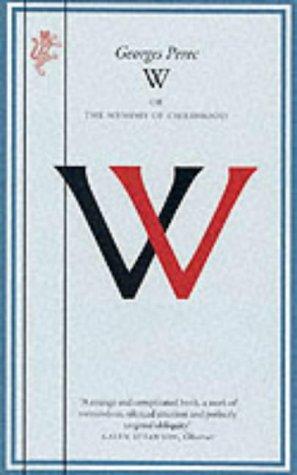
W, or the Memory of Childhood
Georges Perec · 1936–1982 · France
Originally W ou le souvenir d'enfance (French) · translated by David Bellos
Why it matters
Alternating chapters of a sinister sports-obsessed island fable and fragmentary memories of a Jewish childhood during the Occupation slowly reveal themselves as the same story. Perec's most personal and devastating book.
At a glance
Two alternating narratives whose connection is withheld until late.
Deep dive
Perec alternates two stories that seem to have nothing to do with each other, a boy's half-remembered wartime childhood and an adventure yarn about an island nation built entirely around athletic competition, and lets the reader be the one who works out why they're actually the same book.
Written for readers who have finished the book. No plot recap, and nothing here is safe to read first.
Themes & symbolism
Perec alternates, chapter by chapter, two narratives that share nothing on the surface: a fictional adventure story, first imagined in his twenties and revised here, about a castaway who discovers the island of W, a society organized entirely around athletic competition, and a set of autobiographical fragments about Perec's own early childhood in Paris and then in hiding during the Nazi occupation, fragments he repeatedly flags as unreliable, contradicted by documents, contaminated by other people's stories he has absorbed as his own. The book's typographic breaks between the two strands insist on the separation even as the alternation trains the reader to keep hunting for the connection Perec refuses to state directly.
The island of W, introduced as a utopia devoted to Olympic ideals, sport as the pure, meritocratic organizing principle of an entire society, curdles across its chapters into something closer to a concentration camp: races rigged, weak competitors starved and eliminated, victory ceremonies staged for spectators while the actual system runs on humiliation and arbitrary cruelty. Perec never announces the allegory; he lets the sports-utopia vocabulary curdle sentence by sentence until a reader who started out picturing a genial Olympic fantasy realizes, well after the shift has already happened, that the book has been describing a death camp in the language of a stadium the entire time.
Perec's father died as a French soldier in 1940 and his mother was deported to Auschwitz in 1943, when Perec was six, and the autobiographical chapters circle those facts without ever managing to reach them directly, since Perec's own memory of the period is genuinely, admittedly thin, patched together from other people's recollections, official documents, and a handful of possibly invented images he can no longer distinguish from real ones. The book's split form is his solution to a problem he states outright, that he has no memory equal to the catastrophe he's supposed to be remembering, and the fictional W narrative becomes the place that missing, unbearable content goes when direct childhood memory can't hold it.
A Childhood Rewritten Around a Blank
The most quietly devastating detail in the memoir chapters is how little Perec can actually verify about his own early years; even the vivid image of himself as a small boy denouncing another child as Jewish, offered early in the book as a genuine memory, is later undercut when Perec discovers the episode more plausibly belongs to someone else's account he absorbed as his own. Rather than resolve the uncertainty, Perec leaves the contradiction standing in the text, which becomes his most direct statement about a childhood shaped by genocide: the record itself has holes the size of what was destroyed, and no amount of careful reconstruction can fill them back in.
The last seal: what actually happens, and why it lands the way it does.
The ending, explained
The W narrative, having spent its final chapters exposing the sports society's competitions as rigged death matches disguised in Olympic ceremony, breaks off without a conventional resolution, the fictional narrator's account degrading into fragments and gaps that visibly mirror the autobiographical chapters' own fragmentation. The book's actual ending is less plot than convergence: by its final pages the two narratives have become formally identical, both circling an atrocity neither can represent directly, W through allegory that finally admits what it's been describing all along, the childhood chapters through documented facts, a death certificate, a deportation record, that arrive with none of the emotional access memory would have supplied. Perec closes not on resolution but on that shared incapacity, the clearest statement the book makes: that his mother's death at Auschwitz exists for him only as an administrative fact he can cite but never actually remember.
Where to go next
 Georges Perec · 1978Life A User's ManualLvl 8Slow burn
 Raymond Queneau · 1959Zazie in the MetroLvl 5Fast paced
 Italo Calvino · 1972Invisible CitiesLvl 5Slow burn
 Alain Robbe-Grillet · 1957JealousyLvl 8Slow burn
 Annie Ernaux · 2008The YearsLvl 6Slow burn
 Patrick Modiano · 1978Missing PersonLvl 5Medium pace