
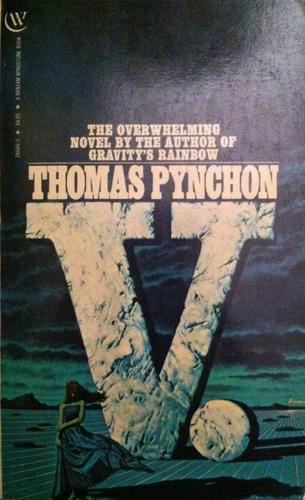
V.
Thomas Pynchon · b. 1937 · USA
Why it matters
A discharged sailor drifts through 1950s New York while a former spy chases the century-spanning trail of a shape-shifting woman named V. through colonial massacres and Mediterranean intrigue. Pynchon's sprawling debut invents the paranoid-history quest whole.
At a glance
A double plot spanning decades and continents buries its patterns under dense historical digression.
Deep dive
Why Herbert Stencil can only ever refer to himself in the third person while chasing a woman who may not exist, and what her body is quietly doing across five decades and four continents that the plot never states outright.
Written for readers who have finished the book. No plot recap, and nothing here is safe to read first.
Themes & symbolism
Pynchon splits the novel between Benny Profane, a discharged sailor drifting inertly among the self-styled bohemians of 1950s New York he calls the Whole Sick Crew, and Herbert Stencil, obsessively reconstructing the identity of 'V.,' a figure his late father, a Foreign Office spy, once mentioned in a diary entry. Stencil refers to himself only as 'Stencil,' never 'I,' a deliberate tactic against what he calls the false intimacy of a memoirist's voice, and Pynchon makes the deflection itself the real subject: a paranoid historian's need for pattern racing well ahead of any proof that a pattern exists at all.
One chapter, set in German South-West Africa in 1904 and narrated through Kurt Mondaugen's retelling of a settler named Foppl's memories, names the historical Herero genocide directly and without flinching, treating that atrocity as the true point of origin the novel's later, decadent, self-absorbed characters are still living downstream of, whether or not they know the history themselves. Across V.'s later appearances, as Victoria Wren, as Veronica Manganese, and finally as the 'Bad Priest' found half dismantled by scavenging children during a Malta air raid, her body grows steadily more mechanical: a glass eye, false teeth, artificial feet. Pynchon makes the encroachment of hardware on flesh literal, so that V. isn't only a woman with a hidden identity but a walking chart of a civilization quietly replacing itself with machinery and calling it progress.
Entropy as the Novel's Real Antagonist
Pynchon was working out the same idea in his contemporaneous short story 'Entropy,' and V. applies it at two scales at once: Profane's aimless yo-yoing between jobs and lovers is entropy read at the level of one directionless man, while V.'s accumulating prosthetics are entropy read across an entire civilization, both of them systems running down toward an inert, undifferentiated sameness that no amount of Stencil's pattern-hunting can reverse.
The Whole Sick Crew, the loose circle of artists and hangers-on Profane drifts among in New York, gives the entropy idea a social form: people producing endless talk about art and politics that generates no actual work, no actual conviction, just heat without motion. Pynchon treats the Crew less as satire of any particular bohemian scene than as a diagnosis of a culture that has run out of energy to convert into anything, which is exactly the condition V.'s own body is quietly modeling one prosthetic at a time.
The last seal: what actually happens, and why it lands the way it does.
The ending, explained
Stencil, chasing testimony in Malta that the Bad Priest killed in the 1942 air raid was V. herself, gets nothing better than secondhand rumor, some claiming the priest had a jeweled navel like V.'s, and departs for Stockholm on yet another lead, no closer to certainty than when he started. Profane, on a beach with his on-and-off companion Paola, is asked whether he's learned anything from everything that's happened, answers no, and simply keeps running down the sand into the dark, the narration cutting off mid-stride. Pynchon denies both plots resolution on purpose: Stencil's genealogy could be extended forever without ever confirming a truth, and Profane's drift was never headed anywhere to begin with, so the novel just stops instead of ending.
Where to go next
 Thomas Pynchon · 1966The Crying of Lot 49Lvl 8Medium pace
 Thomas Pynchon · 1973Gravity's RainbowLvl 10Slow burn
 Thomas Pynchon · 1997Mason & DixonLvl 9Slow burn
 Thomas Pynchon · 2009Inherent ViceLvl 4Fast paced
 Don DeLillo · 1985White NoiseLvl 6Medium pace
 William T. Vollmann · 2005Europe CentralLvl 9Slow burn