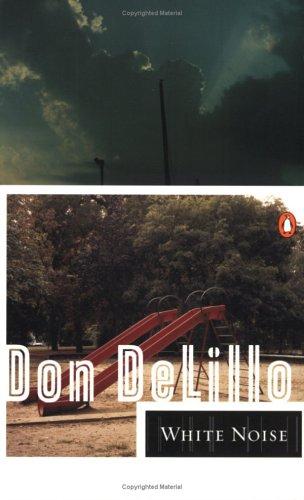
White Noise
Don DeLillo · b. 1936 · USA
Why it matters
A professor of Hitler Studies, an airborne toxic event, and a drug promising the end of the fear of death. The American 1980s caught whole: supermarket aisles humming with dread and tenderness.
At a glance
Deadpan academic jargon and looping dialogue mask a demanding thematic structure.
Deep dive
Why Jack Gladney's whole academic career is built on a language he can't actually speak, and what a black chemical cloud drifting over his town does to a man already terrified of dying.
Written for readers who have finished the book. No plot recap, and nothing here is safe to read first.
Themes & symbolism
White noise — the ambient hum of television, supermarket Muzak, radio chatter, and product names recited like liturgy — is DeLillo's argument that American consumer life drowns the fear of death in continuous low-grade information rather than confronting it. Jack's professorship in Hitler Studies, undermined by the running joke that he can't actually speak German, is a comic version of the same evasion at institutional scale: his colleague Murray Siskind theorizes that tyrants correlate power with immortality, and Jack has built an entire academic identity on proximity to history's most concentrated engine of mass death as a hedge against his own.
The Airborne Toxic Event — the black chemical cloud released by a train derailment — makes that ambient dread visible and evacuable, and DeLillo's sharpest joke is that SIMUVAC, the agency whose job is simulating evacuations for practice, treats the real one mainly as raw material for improving its simulations, reality demoted to a rough draft of its own rehearsal. Dylar, the experimental drug Babette secretly trades sex to obtain from a man calling himself Mr. Gray, promises to erase the fear of death chemically instead of existentially, and its total failure — Mr. Gray turns out to be a ruined figure named Willie Mink, dosed on his own product, unable to tell words from the things they name — is the novel's verdict on any technological shortcut around mortality.
The Most Photographed Barn in America
Murray's set-piece lecture at a tourist attraction — a barn so famous for being photographed that no one can any longer see the barn itself, only the aura generated by the crowd looking at it — condenses the novel's whole thesis about mediated experience replacing direct experience into a single scene, delivered by the character serving as Jack's cheerfully cynical intellectual double.
Hitler Studies as Armor
Murray's own ambition to found an equivalent department of Elvis Studies, modeled explicitly on Jack's success, exposes Hitler Studies as one interchangeable instance of a general academic strategy: convert whatever culture is most obsessed with into tenure, and let borrowed magnitude stand in for a confrontation with one's own mortality neither man is prepared to have directly.
The last seal: what actually happens, and why it lands the way it does.
The ending, explained
Having learned of Babette's affair and the Dylar deal, Jack tracks Willie Mink to a rundown motel and shoots him twice with a pistol borrowed from his father-in-law, then, mid-plan to stage the scene as a suicide, has a change of heart, retrieves the wounded Mink, and drives him to a hospital run by German-speaking nuns. There, one of the sisters tells Jack that she and the others don't actually believe in God or heaven — they perform belief so someone still can, faith reduced to a service the faithless keep running for everyone else. Jack goes home no closer to resolving his fear of death than he started, and the novel's last chapter, watching supermarket shelves get rearranged and disorienting the store's elderly shoppers, closes on the same low hum of dread it opened with.