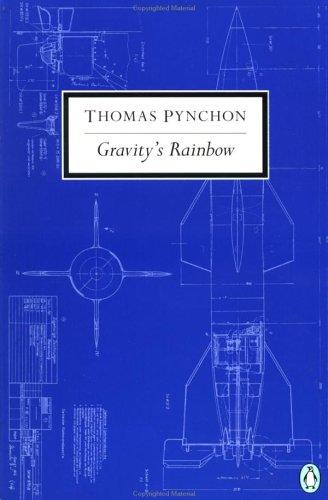
Gravity's Rainbow
Thomas Pynchon · b. 1937 · USA
Why it matters
V-2 rockets, conditioned desire, and four hundred characters across the ruins of 1945: postmodernism's Everest. The Pulitzer board vetoed its own jury over it; the novel outlived the scandal into permanence.
At a glance
Encyclopedic digression, hundreds of characters, and fractured chronology test any reader.
Deep dive
Why a man's erections predicting rocket strikes is the least strange thing about this novel's theology of paranoia, plastic, and the bomb.
Written for readers who have finished the book. No plot recap, and nothing here is safe to read first.
Themes & symbolism
Tyrone Slothrop's map of London girlfriends corresponds, point for point, to the map of V-2 impact sites before the rockets fall — a coincidence that turns out to be conditioning: as an infant he was the subject of a behavioral experiment by Laszlo Jamf, wired so that his erections and the war's death machinery answer to the same stimulus. Pynchon fuses sex and destruction at the level of Pavlovian reflex, then spends seven hundred pages asking whether that fusion is a horrifying aberration or simply modern life's plainest description of itself — a Firm, a System, a They that has already merged desire, industry, and annihilation into a single circuit, and simply waits for bodies willing to close it.
Everyone in the Zone is a theologian without knowing it, sorted by Pynchon into the elect and the preterite — Calvinism's term for those passed over, not chosen, and therefore, perversely, the only characters left free to be interesting. Rocket 00000, the Schwarzgerät built to enclose the boy Gottfried in a skin of Imipolex G (a plastic that becomes erect, an erotic material grown for a purpose nobody involved can fully articulate) under the command of the SS officer Weissmann, who calls himself Blicero, is the novel's most literal marriage of eros and technological death: a child cocooned inside a sex toy built to kill him, launched by a man devoted to both. Entropy, statistics, and behaviorism — Pointsman's dogs against Roger Mexico's probability curves — supply the book's intellectual scaffolding, but its real argument is that paranoia, everything being connected, is the only sane response to a century organized by corporations profiting from both the poison and its antidote.
Slothrop's Disintegration
Somewhere past the novel's midpoint, Slothrop simply stops holding together as a protagonist: he wanders the Zone dressed as Rocketman, a comic-book identity improvised out of a cardboard helmet, loses his socks, his mission, and eventually the narrative's interest in tracking him at all, until other characters start reporting sightings of him the way you'd report weather. Pynchon called this being 'scattered' rather than killed, and it's the novel's most radical formal choice: a nine-hundred-page book abandons its own hero because a coherent self turns out to be exactly what a paranoid, war-profiteering System cannot tolerate existing outside its control.
The Pulitzer That Wasn't
In 1974 the Pulitzer fiction jury unanimously recommended Gravity's Rainbow for the prize; the advisory board overruled its own jury, calling the novel 'unreadable,' 'turgid,' and in places 'obscene,' and gave no fiction award at all that year, the first shutout since 1971. The novel took the National Book Award instead, shared with Isaac Bashevis Singer, and, freed from the Pulitzer's approval, went on to outgrow the scandal entirely, becoming the consensus candidate for the great American postmodern novel that the board too squeamish to crown it had tried to bury.
The last seal: what actually happens, and why it lands the way it does.
The ending, explained
The novel's closing pages jump to a movie theater — the Orpheus, in present-day Los Angeles — where an audience, 'us,' watches a screen go silent an instant before impact: rocket 00000, with Gottfried sealed inside, is already falling, has perhaps already fallen, and is falling still, because Pynchon refuses to let the sentence resolve into a single tense. The narration turns to direct address, urges everybody to join hands and sing a hymn about a hand that 'turns the time,' and breaks off mid-invitation — 'Now everybody—' — with no closing punctuation. Rather than end the war, the passage collapses 1945's rocket onto a Cold War audience sitting in the dark watching movies under a different bomb aimed at a different silence. The apocalypse the novel has spent nine hundred pages not-quite-reaching finally arrives in the second person, mid-gesture, because for Pynchon the missile is always still coming down.