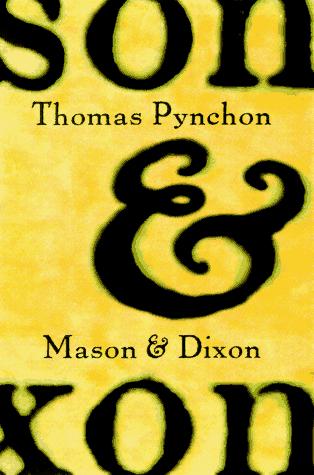
Mason & Dixon
Thomas Pynchon · b. 1937 · USA
Why it matters
The astronomer and the surveyor draw the line that will divide a nation, narrated by a garrulous parson in mock-eighteenth-century prose complete with a talking dog and a mechanical duck. Pynchon's tenderest book wears its pastiche like a disguise for real grief.
At a glance
Sustained eighteenth-century pastiche diction and digressive length make for a slow, demanding read.
Deep dive
What Pynchon means by giving the men who drew America's most consequential boundary line a talking dog and a lovesick mechanical duck for company, and what the line itself is doing to the land long before anyone starts calling it the border between free and slave states.
Written for readers who have finished the book. No plot recap, and nothing here is safe to read first.
Themes & symbolism
Pynchon frames the whole story as a tale told years later by the fictional Reverend Wicks Cherrycoke to a houseful of restless nieces and nephews on Christmas, a narrative-within-narrative that lets him write in a dense, deliberately archaic eighteenth-century pastiche, complete with a talking Learned English Dog, a sentient mechanical duck built by an obsessive French chef and in love with its own creator, and digressions into Cape Colony astronomy postings and Chinese feng shui. The excess isn't just comic texture. Pynchon uses the sheer accumulated strangeness of the period's actual science, superstition, and colonial enterprise to argue that the eighteenth century's rationalism was always shot through with exactly this much unmanaged wonder and dread, whatever the Enlightenment later claimed about itself.
The line Mason and Dixon actually survey, cut in a straight, geometrically indifferent gash across hundreds of miles of forest, farmland, and Native territory to settle a colonial property dispute between the Penns and the Calverts, is treated throughout as an act of violence against a landscape that had its own older logic before the theodolite ever arrived. Pynchon has Mason and Dixon themselves grow increasingly uneasy at what their work will be used for, aware in ways the historical record can't confirm that a boundary drawn to settle one property argument is about to become the line the country uses to argue about slavery, a foreshadowing the novel keeps quiet and mounting rather than announced.
A Grief the Whole Book Is Encoded to Carry
Mason's dead wife, Rebekah, appears to him repeatedly throughout the novel as a ghost only he can perceive, a private sorrow running underneath all the picaresque comedy of talking animals and colonial farce. Dixon, by contrast, carries his grief outward as anger, most visibly in his fury at witnessing slavery directly in Cape Town and later in the American colonies, and the friendship between the two men, one grieving inward, one outward, becomes the novel's real emotional spine underneath its dazzling accumulation of period detail, the two griefs steadying each other across ten years of shared surveying work.
The last seal: what actually happens, and why it lands the way it does.
The ending, explained
Mason and Dixon complete their survey and part ways, their partnership never quite resolving into the deeper friendship the years of shared work seemed to be building toward, each man returning to an ordinary, diminished postscript of a life after the historic undertaking that will outlast both their names. Mason eventually returns to America seeking a fresh start and dies in Philadelphia in poverty, tended in his final illness by Benjamin Franklin, while Dixon dies quietly back in England, and Pynchon declines to give either man a triumphant late chapter, insisting instead that the line they drew would go on to matter far more to history than either of the men who drew it.