
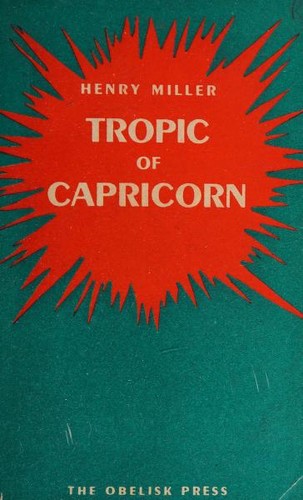
Tropic of Capricorn
Henry Miller · 1891–1980 · United States
Why it matters
Miller recasts his years as a Western Union personnel manager in 1920s New York into a raging, digressive assault on American respectability and sex. The autobiographical companion piece to Tropic of Cancer, banned for decades.
At a glance
Free-associative, ranting digressions with little conventional plot to anchor the reader.
Deep dive
How Henry Miller turns his years running the hiring desk at a thinly disguised Western Union into the origin story he needed before he could become the writer of Tropic of Cancer.
Written for readers who have finished the book. No plot recap, and nothing here is safe to read first.
Themes & symbolism
Tropic of Capricorn works backward from the Paris of Tropic of Cancer to the New York Miller left behind, centered on his years managing personnel for the Cosmodemonic Telegraph Company, a barely fictionalized Western Union, where he hired and fired a rotating cast of Depression-desperate messenger boys and absorbed, daily, the human cost of a system built to grind them down. Miller writes the job less as employment than as a kind of captivity, one he escapes only in memory and in the sexual encounters he narrates with a candor that got the book banned in the United States and Britain for decades.
The prose refuses conventional narrative shape almost entirely, looping through digressions on his crumbling first marriage, his contempt for American respectability, and his own artistic paralysis with no throughline holding the chapters together except Miller's own accumulating rage. That formlessness is the point: Miller is writing against the tidiness of the success story America expected from a man his age, and the book's chaos is its argument that a life spent inside Cosmodemonic's machinery couldn't produce anything shaped like a normal plot.
A Prequel Named for Its Own Author's Birth
Miller was born on December 26th, under the sign of Capricorn, and naming the New York volume after his own birth sign while the Paris volume carries Cancer's positions the two books as a matched pair: one an origin story rooted in where he came from, the other a record of the disease he had to contract in order to become who he became. Read together, the titles turn Miller's autobiography into its own astrological cosmology, self-mythologizing on a scale few writers attempt this literally.
Sex as the Counter-Language to Cosmodemonic
Against Cosmodemonic's dehumanizing efficiency, Miller sets up sex as the one register in which he still feels fully alive, cataloguing affairs with a bluntness meant to scandalize the same respectable America the telegraph company represents. The two registers, corporate euphemism and sexual bluntness, sit deliberately side by side throughout the book, and the collision is Miller's whole method: obscenity as the honest language a sanitized culture won't let itself speak.
Where to go next
 Henry Miller · 1934Tropic of CancerLvl 7Slow burn
 Gertrude Stein · 1933The Autobiography of Alice B. ToklasLvl 5Medium pace
 John Dos Passos · 1925Manhattan TransferLvl 6Medium pace
 Ernest Hemingway · 1926The Sun Also RisesLvl 4Fast paced
 F. Scott Fitzgerald · 1925The Great GatsbyLvl 4Fast paced
 Djuna Barnes · 1936NightwoodLvl 9Slow burn