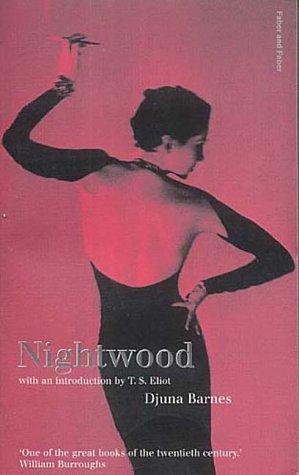
Nightwood
Djuna Barnes · 1892–1982 · United States
Why it matters
A doomed love between women circles through the ravings of a fraudulent doctor in expatriate Paris. Barnes's baroque, incantatory masterpiece, championed by T. S. Eliot: prose like scripture written in the dark.
At a glance
Dense, incantatory prose and a circling, plotless structure demand very close reading.
Deep dive
An elusive woman drifts through the lovers who worship her in 1920s Paris, narrated in prose so dense it reads closer to liturgy than fiction — Barnes's argument that desire outruns whatever language we have for it.
Written for readers who have finished the book. No plot recap, and nothing here is safe to read first.
Themes & symbolism
Robin Vote is less a character than a vacancy every other figure in the novel tries and fails to fill with meaning: Felix Volkbein, a self-invented "Baron" whose aristocratic lineage is pure fabrication, marries her hoping to found a real dynasty on a fiction; Nora Flood loves her with a totalizing, self-erasing devotion that reads as worship rather than partnership; Jenny Petherbridge possesses her the way a collector possesses an object, jealously and without real understanding. Robin herself never settles, never becomes legible even to the reader in ordinary psychological terms — Barnes withholds her interiority almost entirely, rendering her only through the effect she has on everyone orbiting her, which is the novel's whole point: desire this intense doesn't clarify its object, it obscures it, and every attempt to fix Robin into a single relationship or a single identity is doomed by her fundamental resistance to being fixed at all.
Barnes's prose style is itself the argument: dense, aphoristic, closer to scripture or incantation than realist narration, deliberately difficult in a way that enacts the novel's claim that the desire it circles — queer desire with no vocabulary the period offers it directly — exceeds language's ordinary capacity to hold it. Dr. Matthew O'Connor's extended monologues, sprawling through theology, gender, the night as a symbolic register of unguarded truth against the day's social performance, function as the novel's real intellectual center: a fraudulent, cross-dressing, unlicensed gynecologist whose own gender nonconformity makes him simultaneously the book's most vivid outsider and its sharpest, saddest commentator on how thoroughly identity resists the coherent narratives everyone, including the reader, keeps trying to impose on it.
Eliot's Patronage and the Novel's Reception
T. S. Eliot championed Nightwood into print at Faber and wrote its introduction, explicitly framing it as a work to be read for its poetic prose rather than judged as a conventional novel — a framing that both rescued the book from obscurity and shaped, for decades afterward, a critical reception that treated it as a modernist curiosity more admired than read. That reputation has shifted considerably: contemporary queer and feminist criticism has recovered Nightwood as one of the era's few sustained attempts to render lesbian desire in serious literary prose, its difficulty reread not as inaccessibility but as the necessary form for content the period had no other way to say. Barnes herself, notoriously prickly about her own sexuality and about the book's basis in her real, devastating affair with the sculptor Thelma Wood, resisted any simple autobiographical reading even while the novel's raw grief made the connection unmistakable.
The Final Scene, Left Deliberately Unresolved
The novel's famous closing image — Nora finding Robin in a decaying chapel, where she drops to all fours before Nora's dog in a scene of ambiguous, near-ritual communion with the animal — has never settled into a single agreed reading among critics: total psychological breakdown, a pagan return to something pre-human and pre-linguistic, or simply Barnes's last image for a desire the whole book has argued was never nameable in human terms to begin with. It resists paraphrase on purpose, refusing the kind of narrative closure the rest of the novel has already spent two hundred pages arguing Robin was never going to permit.