
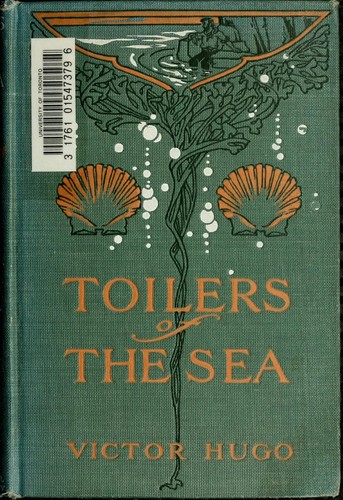
Toilers of the Sea
Victor Hugo · 1802–1885 · France
Originally Les Travailleurs de la mer (French)
Why it matters
A lone fisherman battles a wrecked ship's tangled machinery, a killer storm, and a giant octopus to win the woman he loves: Hugo's epic of man against pitiless nature, and the novel that gave the world its first great monster-octopus scene.
At a glance
Long descriptive passages on sea, weather, and machinery slow the adventure plot.
Deep dive
Why the one adversary in this novel that never once behaves like a villain is exactly what makes its ending land harder than anything Javert or Frollo could have managed.
Written for readers who have finished the book. No plot recap, and nothing here is safe to read first.
Themes & symbolism
Gilliatt, an isolated, half-suspected fisherman on Guernsey, spends months alone salvaging the wrecked steamship Durande's engine from a reef battered by tide, storm, and hunger, in exchange for the hand of Déruchette, the shipowner's niece he has loved from a distance without ever declaring it; Hugo builds the whole middle of the novel as a single extended contest between one stubborn, competent man and an indifferent sea that offers no malice and no mercy, only weather and physics. That impersonality is the point: Hugo had already given his readers a corrupt institution to fight in Notre-Dame and an unjust social order to fight in Les Misérables, and here he deliberately strips the antagonist of any moral content at all, forcing Gilliatt's whole heroism to register as competence against pure indifference rather than righteousness against wrong.
The famous fight with the devil-fish in a sea cave, an octopus that pins Gilliatt against a rock wall in exhaustive, almost anatomical detail, is less a monster-movie set piece than Hugo's summation of the sea's whole character: something that kills without hatred, simply because it can, and Gilliatt's survival owes nothing to virtue and everything to nerve and a knife. Clubin, the treacherous pilot who deliberately wrecks the Durande to steal a hidden fortune and drowns fleeing with it, supplies the one genuinely human villainy in the book, and Hugo positions him at a careful distance from Gilliatt's real struggle, since greed is comprehensible and punishable while the sea itself is neither.
The Durande's steam engine, viewed with open suspicion by Guernsey's older sailors as an unnatural intrusion on a trade governed by wind and tide, gives Lethierry's whole enterprise a second, quieter conflict running underneath Gilliatt's physical ordeal: an old shipowner's stubborn faith in a new technology against a community that has not yet decided to trust it. Gilliatt's success in recovering the engine intact ends up vindicating that faith, but Hugo is careful not to let the vindication read as any kind of triumph over the sea itself, only as one further proof that machinery, however cleverly built, still has to survive contact with a force that was never going to negotiate.
Guernsey Written From Exile
Hugo wrote the novel during his own long political exile on Guernsey, and the island's geography, its reefs, tides, and isolated cottages, is rendered with a returned resident's exact familiarity rather than a tourist's impression. Gilliatt's solitary contest with an indifferent, overwhelming force reads plausibly as Hugo's own oblique self-portrait, a stubborn man laboring alone against forces vastly larger than himself, far from the political center that exiled him, refusing to be beaten by conditions he never chose.
The last seal: what actually happens, and why it lands the way it does.
The ending, explained
Gilliatt returns triumphant with the salvaged engine, exactly fulfilling the bargain Lethierry set for Déruchette's hand, only to discover that she has fallen in love with Ebenezer Caudray, the new young pastor, while he was gone. Rather than claim the reward he earned by the letter of the promise, Gilliatt quietly arranges the couple's wedding himself and watches their ship depart from the Gild-Holm-'Ur seat, a rock formation on the coast. As the tide rises around him, he remains seated without moving, and Hugo lets the sea simply take him, the same indifferent force he spent the whole novel outlasting finally closing over a man for whom there was no longer any reason left to keep fighting it.
Where to go next
 Victor Hugo · 1829The Last Day of a Condemned ManLvl 3Slow burn
 Victor Hugo · 1831The Hunchback of Notre-DameLvl 5Slow burn
 Victor Hugo · 1862Les MisérablesLvl 5Slow burn
 Victor Hugo · 1869The Man Who LaughsLvl 6Medium pace
 Victor Hugo · 1874Ninety-ThreeLvl 5Medium pace
 Gustave Flaubert · 1857Madame BovaryLvl 5Slow burn