
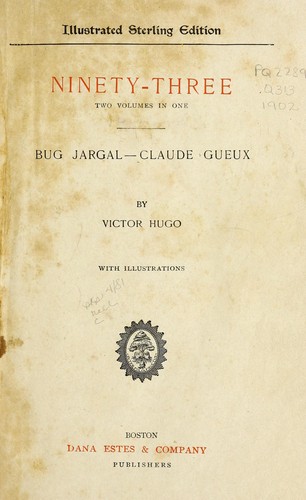
Ninety-Three
Victor Hugo · 1802–1885 · France
Originally Quatrevingt-treize (French)
Why it matters
A royalist marquis, the republican general who once raised him, and a fanatical priest converge on the same Vendée farmhouse during the Revolution's civil war: Hugo's final novel weighs mercy against ideology and finds neither side innocent.
At a glance
Dense historical and political argument frames a tightly plotted siege story.
Deep dive
Three men, each answering to a different absolute code of honor in the middle of a civil war, and what refusing to bend on any one of those codes actually asks of each of them.
Written for readers who have finished the book. No plot recap, and nothing here is safe to read first.
Themes & symbolism
Hugo sets his last novel inside the Vendée uprising of 1793, a royalist counter-revolution against the young French Republic fought with a brutality on both sides that the novel refuses to soften, and structures the whole book around three men rather than the single moral binary that organized Les Misérables: the Marquis de Lantenac, an aristocratic royalist commander of total, almost inhuman ruthlessness; Cimourdain, a former priest turned fanatical revolutionary tribunal judge who accepts no exception to law regardless of personal cost; and Gauvain, Lantenac's own great-nephew and Cimourdain's former pupil, a revolutionary commander trying to hold humane feeling and revolutionary duty together at once.
Lantenac, having ordered a chateau burned as a tactical move against the republicans sheltering inside it, turns back at the last possible moment to rescue three peasant children trapped in the flames, an act of mercy with no strategic value whatsoever that costs him his own capture; Hugo is careful not to soften anything else about the man, his massacres and his politics remain intact, which makes the single uncalculated kindness land as a genuine crack in an otherwise total ideology rather than a redemption arc. Gauvain, moved past reason by that one act, frees his own prisoner and takes Lantenac's place to face the tribunal himself, a decision Hugo frames not as weakness but as an attempt to answer absolute revolutionary law with something the law has no category for.
Cimourdain's dilemma is the novel's real engine: bound by his own uncompromising revolutionary principles and by an explicit government order that any officer who frees a captured enemy commander must be executed, he is forced to preside over the tribunal condemning Gauvain, the pupil he loves more than anything else in his life, to the guillotine. Hugo refuses either man an escape from his own code, and the tragedy isn't that one side is right and the other wrong, it's that a civil war built on absolute principle eventually asks every one of its true believers to destroy exactly what they love most in order to remain consistent.
A Civil War With No Clean Side
Hugo had spent decades as republican France's most visible literary conscience, yet he wrote Lantenac's royalist brutality and Cimourdain's revolutionary fanaticism with equal, unflinching detail, refusing his own late-career novel the comfort of an uncomplicated political hero. The Vendée war's actual historical toll, entire villages destroyed by both republican and royalist forces alike, sits under the fiction as documented fact rather than invention, and Hugo's choice to build his final novel around three men who each destroy something they value in the name of an uncompromising code reads as his own considered verdict on where pure ideological consistency, on any side, eventually leads.
The last seal: what actually happens, and why it lands the way it does.
The ending, explained
The tribunal, with Cimourdain casting the deciding vote himself, condemns Gauvain to death despite Cimourdain's evident agony over the sentence, since revolutionary law as he understands it permits no personal exception even for the pupil he raised and loves as a son. Gauvain goes to the guillotine calmly, having accepted the logic of the very system that is about to kill him, and at the precise moment the blade falls, Cimourdain shoots himself through the heart, his own body giving out at the exact instant his principles finally cost him everything he had left to lose. Hugo closes the trilogy of his late fiction on that double death rather than on any surviving synthesis, leaving Lantenac's mercy, Cimourdain's law, and Gauvain's attempt to honor both as three positions the novel refuses to rank, only to show each one paid for in full.
Where to go next
 Victor Hugo · 1829The Last Day of a Condemned ManLvl 3Slow burn
 Victor Hugo · 1831The Hunchback of Notre-DameLvl 5Slow burn
 Victor Hugo · 1862Les MisérablesLvl 5Slow burn
 Victor Hugo · 1866Toilers of the SeaLvl 5Fast paced
 Victor Hugo · 1869The Man Who LaughsLvl 6Medium pace
 Gustave Flaubert · 1857Madame BovaryLvl 5Slow burn