
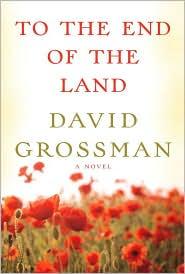
To the End of the Land
David Grossman · b. 1954 · Israel
Originally Isha Borahat Mibesorah (Hebrew) · translated by Jessica Cohen
Why it matters
A mother walks out of her house rather than receive news of her soldier son, so the messengers can never find her. Written as Grossman's own son served in the military, then completed after his death: grief and politics fused into an unbearable wait.
At a glance
Long, interiorized sentences and a fragmented, memory-driven timeline over a huge canvas.
Deep dive
On the walk that structures the whole book, and why refusing to be found becomes its own kind of protest against the state's claim on a mother's grief.
Written for readers who have finished the book. No plot recap, and nothing here is safe to read first.
Themes & symbolism
Ora's narration to Avram is not backstory, it's the engine of the whole novel: by narrating Ofer's entire childhood, adolescence, and enlistment in obsessive, granular detail, she is trying to hold him in existence through sheer verbal insistence, as though a life fully spoken can't simply stop. The logic is magical and she half-knows it: if she cannot be found, the news cannot be delivered, and if the news cannot be delivered, the death — should it come — remains suspended, not yet real. Walking becomes a way of outrunning a sentence rather than a place.
Avram's presence on the walk turns the same material into repair. Broken by torture he survived as a POW in 1973, he has spent decades refusing intimacy, including with the boy who may or may not be his biological son — a question the novel treats as almost beside the point, since paternity here is made of attention, not chromosomes. By forcing him to receive Ofer's whole life secondhand, Ora is giving Avram the fatherhood his own damage stole from him, years too late to matter to Ofer directly but not too late to matter to Avram, or to her. Grossman structures the whole book as this transfer in slow motion — the walk has no other real destination, and the closer Ora and Avram get to finishing the story, the closer the novel gets to whatever is waiting for her at the end of it.
Fleeing the Notifiers
Israeli military protocol sends officers to a soldier's home to deliver news of death in person, and Ora's entire journey is built on the folk-magical loophole in that protocol: an empty house can't receive a visit. It's a domestic, almost absurd form of civil disobedience, refusing not the war but the state's presumed right to determine when and how a mother must learn to grieve. That the gesture is futile — the news, if it comes, will find her eventually — doesn't make it irrational; it's the only agency left to a woman whose son's life is otherwise entirely in other people's hands.
Written Beside a Real War
Grossman was deep in the manuscript when his own son Uri, then serving in the army, was called up for the 2006 Lebanon war; he stopped writing, and Uri was killed days before the ceasefire. Grossman finished the book afterward. Nothing in the text directly narrates that loss, but the fact has become impossible to read around: a novel about the dread of losing a son to a war, written by a father who did, turns Ora's magical thinking from a literary device into something closer to a wish the author's own life refused to grant. It also explains why the book resists any tidy political message about the conflict itself: Grossman is not arguing a policy position so much as recording, in real time, what the demand for perpetual military readiness costs the people who love the ones sent to meet it.
The last seal: what actually happens, and why it lands the way it does.
The ending, explained
The walk simply ends; the novel never tells us whether Ofer survives the operation he reenlisted for. Ora and Avram return from the Galilee with Ofer's life now fully lodged in Avram as well as in her, but the dread that has propelled every page is left exactly where it started, unresolved on the page as it is unresolved in life. That refusal isn't a cop-out — it's the book's whole argument in miniature: certainty was never on offer, waiting doesn't produce answers, and the walking, the talking, the narrating were never a means to an ending but a way of living inside the not-knowing itself.
Where to go next
 David Grossman · 1986See Under: LoveLvl 8Slow burn
 David Grossman · 2014A Horse Walks into a BarLvl 6Fast paced
 A. B. Yehoshua · 1977The LoverLvl 7Slow burn
 Amos Oz · 2002A Tale of Love and DarknessLvl 6Slow burn
 S. Y. Agnon · 1935A Simple StoryLvl 5Medium pace
 Leo Tolstoy · 1878Anna KareninaLvl 5Medium pace