
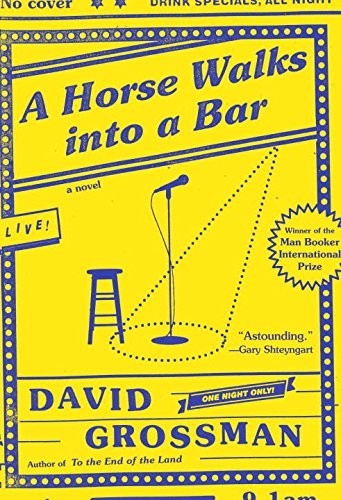
A Horse Walks into a Bar
David Grossman · b. 1954 · Israel
Originally Sus Ehad Nichnas LeBar (Hebrew) · translated by Jessica Cohen
Why it matters
A stand-up comedian's late-night set in a small Israeli town curdles from jokes into memoir and confession, an audience trapped watching a man perform his own breakdown. Winner of the International Booker Prize in 2017, Grossman's harshest, funniest anatomy of grief yet.
At a glance
A single continuous stand-up monologue shifts rapidly between jokes and unbearable confession.
Deep dive
A stand-up set performed for one specific audience member, invited decades after a shared childhood to watch and finally render a verdict — and how many jokes it takes before the comedian stops performing and starts confessing.
Written for readers who have finished the book. No plot recap, and nothing here is safe to read first.
Themes & symbolism
Dovaleh's comic gift is revealed, over the course of a single deteriorating set, as a survival mechanism forged in catastrophe rather than a talent: as a boy summoned from military camp to a parent's funeral, not told which parent had died, he fills the unbearable uncertainty of the car ride by clowning and tumbling for the soldiers driving him, a compulsive performance of likability that only later reveals itself as the exact shape his whole adult persona has taken. The mother he was anxiously managing his entire childhood — unstable, subject to breakdowns he tried to preempt by being funny, being good, being whatever kept her steady — dies off-page in his boyhood and returns, unnamed for most of the set, as the real subject every joke has been circling.
Grossman's structural choice is the argument: by narrating almost entirely through the transcript of a comedy set, he makes the reader complicit in the same trapped position as the audience, watching entertainment curdle into exposure in real time with no authorial escape hatch. Avishai Lazar, the retired judge Dovaleh specifically invited and seated in the front row, is asked not merely to watch but to *see* — his profession is the pointed detail, since Dovaleh is quite literally asking an old acquaintance to judge the life he's about to lay bare, and to report an honest verdict rather than a comfortable one.
The Set as Novel
The book never leaves the club, unfolding in the compressed real time of one continuous performance, heckles and drink orders and all — a formal choice that makes Dovaleh's disintegration feel less like a story being told than an accident happening live. There's no safe narrative distance available to the reader any more than there is to the audience onstage with him; both are stuck watching a man's persona fail in front of them with no intermission.
The last seal: what actually happens, and why it lands the way it does.
The ending, explained
The set never recovers its comic register: by the time Dovaleh finishes the story of the funeral car, most of the audience has walked out disgusted or embarrassed, and what began as an evening of jokes ends as public humiliation rather than any kind of catharsis or triumph — Grossman refuses to let confession function as redemption. Lazar is left holding the verdict he was invited to deliver, and the novel's closing note is his own reckoning with what judgment even means for a man he half-remembers, half-recognizes, and has just watched dismantle himself for an audience that mostly didn't want to see it.
Where to go next
 David Grossman · 1986See Under: LoveLvl 8Slow burn
 David Grossman · 2008To the End of the LandLvl 6Slow burn
 A. B. Yehoshua · 1977The LoverLvl 7Slow burn
 Amos Oz · 2002A Tale of Love and DarknessLvl 6Slow burn
 S. Y. Agnon · 1935A Simple StoryLvl 5Medium pace
 Leo Tolstoy · 1878Anna KareninaLvl 5Medium pace