
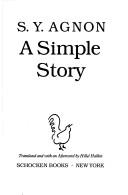
A Simple Story
S. Y. Agnon · 1887–1970 · Ukraine (Galicia) / Israel
Originally Sippur Pashut (Hebrew)
Why it matters
A shopkeeper's son is torn between the poor cousin he loves and the proper match his mother has planned for him, his quiet unraveling narrated in deadpan folk-tale prose. Agnon's clearest, most devastating anatomy of a life shrunk to fit convention.
At a glance
Plain, folk-tale-style prose carries real psychological subtlety beneath its simplicity.
Deep dive
The title is the novel's own joke: how a young man's collapse gets folded, note by note, back into the ordinary life everyone around him insists on calling recovery.
Written for readers who have finished the book. No plot recap, and nothing here is safe to read first.
Themes & symbolism
Hirshl Hurvitz grows up in the merchant town of Szybusz in love with Blume Nacht, a poor orphaned relative taken into his family's household as an unpaid servant, and just as clearly ineligible, by the town's own unspoken accounting, to marry into the family she keeps house for. His mother Tsirl arranges his marriage instead to his cousin Mina Ziemlich, a match built on property and standing rather than feeling, and Agnon narrates the negotiation with the same brisk, communal matter-of-factness the town uses to discuss any transaction, because to Szybusz that is precisely what it is.
Hirshl's interior collapse, once the marriage is settled, is rendered from close inside his disintegration, obsessive routines, mounting confusion, a mind quietly coming apart under the weight of a desire it was never permitted to name. Agnon's narrator keeps the same gently ironic, gossipy town-voice going throughout, which is the novel's sharpest device: the very tone that made Hirshl's marriage sound reasonable is the tone that now narrates his breakdown as a minor domestic inconvenience, and the gap between what is happening to him and how blandly it gets described is where the book's real cruelty lives.
Blume herself is barely permitted an interior life on the page, kept at the edges of scenes she should by rights be central to, and that formal marginalization mirrors her actual standing in the household exactly: a girl useful enough to raise, feed, and rely on, but never once considered a plausible match once real money and status are on the table. Agnon lets the town's easy cruelty toward her pass without editorial comment, which is its own kind of judgment, since the narrator's silence on the injustice matches the silence every character in Szybusz maintains about it too.
Dr. Langsam's Slow Cure
The sanatorium doctor who treats Hirshl is named, with a bluntness Agnon clearly intends, Langsam: German and Yiddish for 'slow.' His method is not to help Hirshl recover whatever he lost in giving up Blume but to walk him gradually back toward accepting the life Szybusz had already chosen for him, session by patient session, until wanting something else no longer registers as a symptom worth treating. The cure Langsam offers is indistinguishable, by design, from resignation.
The last seal: what actually happens, and why it lands the way it does.
The ending, explained
Hirshl returns from the sanatorium and resumes his place in Szybusz exactly where it was left for him: a diligent, unremarkable shopkeeper, a dutiful husband to Mina, father to their child, indistinguishable from any other respectable young man in town. Blume recedes into the background of other people's lives, mentioned in passing rather than mourned. Agnon reports all of this in the same even, folkloric register the whole novel has used from its first page, refusing the reader any signal that something has been lost. That flatness is the final irony the title has been promising all along: this is what a simple story looks like when the alternative was ever wanting something the town had not already approved.
Where to go next
 David Grossman · 2008To the End of the LandLvl 6Slow burn
 Amos Oz · 2002A Tale of Love and DarknessLvl 6Slow burn
 A. B. Yehoshua · 1977The LoverLvl 7Slow burn
 F. Scott Fitzgerald · 1925The Great GatsbyLvl 4Fast paced
 Frans Eemil Sillanpää · 1931The Maid SiljaLvl 4Medium pace
 Leopoldo Alas "Clarín" · 1885La RegentaLvl 6Slow burn