
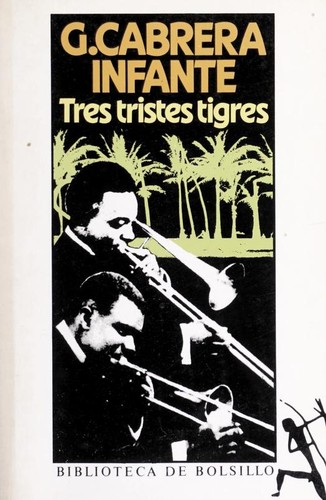
Three Trapped Tigers
Guillermo Cabrera Infante · 1929–2005 · Cuba
Originally Tres tristes tigres (Spanish) · translated by Donald Gardner and Suzanne Jill Levine
Why it matters
Pre-Castro Havana's nightlife is chased through puns, parody, and transcribed voices in a linguistic carnival. The Boom's most purely playful, notoriously untranslatable masterpiece.
At a glance
Puns, phonetic transcription, and wordplay make it notoriously difficult to parse or translate.
Deep dive
Why the funniest, most purely verbal novel of the Boom is also, underneath the puns, an elegy — for a friend, a city, and a way of talking that couldn't survive being written down.
Written for readers who have finished the book. No plot recap, and nothing here is safe to read first.
Themes & symbolism
The novel has almost no plot because its real subject is voice itself: a floating cast of friends — Cué, Silvestre, Códac, Eribó — drift through Havana's pre-revolutionary cabaret world, and Cabrera Infante renders them almost entirely through transcribed talk, parody, and wordplay rather than narrated action. At the center, mostly offstage by the time the book gets going, is Bustrofedon, a legendary talker whose genius was pure improvisation — puns, palindromes, impressions, jokes that existed only in the instant of being spoken and were never written down. His death partway through turns the second half of the novel into a wake conducted in his own idiom: the friends try to reconstruct his voice from memory, quoting him, imitating him, parodying the way he parodied others, and always failing, because the thing that made him remarkable was precisely that it couldn't be fixed on a page.
That failure is the novel's real irony and its real subject. A book this obsessed with orality, transcription, and mimicry keeps demonstrating that writing is always a step behind the living voice it's chasing — every attempt to capture Bustrofedon produces only a copy of a copy, funny and moving but never him. Read against Cabrera Infante's own position when he wrote it, in London exile after breaking with Castro's Cuba, the whole novel becomes an act of the same doomed recovery: an attempt to preserve, in language, a pre-revolutionary Havana nightlife that no longer existed and that no prose, however virtuosic, could actually bring back — only imitate, parody, and mourn.
Cabrera Infante's Exile and a Havana That Vanished
Cabrera Infante had been a cultural insider of the revolution before he was an exile from it: he ran Lunes de Revolución, the regime's own literary supplement, until the 1961 censorship of P.M., a documentary short about Havana nightlife co-made by his brother, brought him into direct conflict with Castro's government over its famous ultimatum to artists — 'within the revolution, everything; against the revolution, nothing.' He left Cuba for good in 1965 and wrote Three Trapped Tigers in London, which means the novel's dazzling, funny surface sits over a real loss: the book is a monument to a nightlife culture, and a country, that the revolution had already closed off to its own author by the time he finished describing it.
A Novel That Can't Be Translated, Only Rewritten
The Spanish title, Tres Tristes Tigres, is itself a tongue-twister, and the novel is built from puns, spoonerisms, and Cuban slang so specific to time and place that literal translation was never an option; the English version, worked out between Cabrera Infante and his translators, essentially invents a parallel set of English wordplay rather than converting the Spanish jokes one for one. That makes Three Trapped Tigers unusual among translated novels — the English text is less a translation than a second original, written in collaboration with the author, which fits a book whose whole argument is that voice can be imitated brilliantly but never truly transferred intact from one register, or one language, to another.
Where to go next
 José Donoso · 1970The Obscene Bird of NightLvl 9Slow burn
 Carlos Fuentes · 1962The Death of Artemio CruzLvl 8Slow burn
 Augusto Roa Bastos · 1974I, the SupremeLvl 9Slow burn
 José Lezama Lima · 1966ParadisoLvl 10Slow burn
 Jorge Ibargüengoitia · 1977The Dead GirlsLvl 4Fast paced
 Fernando del Paso · 1977Palinuro of MexicoLvl 9Slow burn