
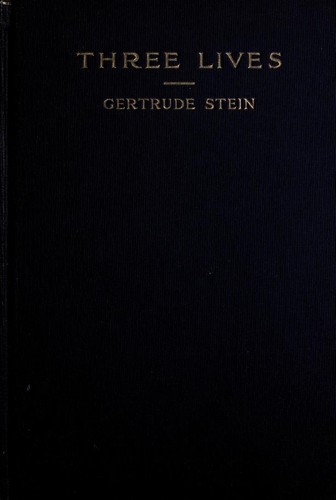
Three Lives
Gertrude Stein · 1874–1946 · United States
Why it matters
Three working-class women in a fictional Pennsylvania town live and die in prose that repeats, circles, and refuses to resolve into tidy sentences. Stein's first book, the earliest American experiment in what modernism could sound like.
At a glance
Deliberately repetitive, circling sentence rhythms that resist conventional narrative momentum.
Deep dive
What Gertrude Stein's repetition-built prose does to three ordinary women's lives that a conventional style couldn't, and why the middle of the three still divides readers over its portrait of race.
Written for readers who have finished the book. No plot recap, and nothing here is safe to read first.
Themes & symbolism
"The Good Anna," "Melanctha," and "The Gentle Lena" each track a working-class woman in the fictional town of Bridgepoint through Stein's signature technique: sentences that circle back on the same handful of words, mean, patient, good, wandering, wisdom, adding a small variation each time rather than advancing by conventional narrative momentum. Stein developed the method partly out of her psychology training under William James at Radcliffe, where she studied habitual, patterned behavior in test subjects; the prose doesn't just describe repetitive lives, it enacts the same repetition at the sentence level, so that Anna's compulsive service to a string of demanding employers or Lena's passive drift into a marriage nobody bothers to ask her about reads less like plot and more like temperament rendered as syntax.
Melanctha Herbert, the middle and by far the longest of the three lives, follows a mixed-race woman through a series of relationships, most extensively with Dr. Jeff Campbell, in a portrait Richard Wright and Ernest Hemingway both credited as an influence on their own prose rhythms, and one that later critics have interrogated for how thoroughly Stein's wandering vocabulary maps onto period stereotypes about Black women even while granting Melanctha an interior life none of Stein's contemporaries were affording Black characters at all. Three Lives holds both of those readings at once, formally radical and, in its racial vocabulary, a document of exactly when it was written.
Trois Contes, Americanized
Stein modeled the book's structure directly on Flaubert's Trois Contes, translating "Un Coeur simple," the story of a devoted servant, sentence by sentence before writing "The Good Anna" as her own answer to it. Where Flaubert's Félicité gets a lifetime of self-erasing devotion rewarded with a hallucinated parrot standing in for the Holy Spirit, Stein strips out the religious consolation entirely: Anna's decades of managing other people's households earn her nothing transcendent, just more households to manage until her heart gives out.
What Hemingway Took From Melanctha
Hemingway read Three Lives while apprenticing himself to Stein in 1920s Paris and later said Melanctha's dialogue taught him more about writing American speech than almost anything else he'd encountered, particularly Stein's trick of having characters repeat each other's phrases back with a slight shift in emphasis, turning ordinary conversation into something closer to musical variation. The flat, iterative rhythm of early Hemingway dialogue, characters restating each other with small differences rather than building toward resolution, traces straight back to the arguments Jeff Campbell and Melanctha have on Bridgepoint's back porches.
Where to go next
 Gertrude Stein · 1933The Autobiography of Alice B. ToklasLvl 5Medium pace
 Henry James · 1881The Portrait of a LadyLvl 6Slow burn
 Henry Miller · 1934Tropic of CancerLvl 7Slow burn
 John Dos Passos · 1925Manhattan TransferLvl 6Medium pace
 F. Scott Fitzgerald · 1925The Great GatsbyLvl 4Fast paced
 Ernest Hemingway · 1926The Sun Also RisesLvl 4Fast paced