
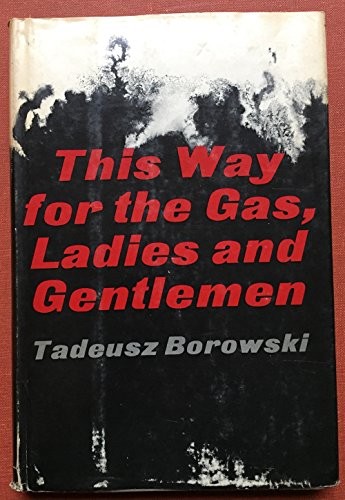
This Way for the Gas, Ladies and Gentlemen
Tadeusz Borowski · 1922–1951 · Poland
Originally This Way for the Gas, Ladies and Gentlemen (Polish)
Why it matters
A prisoner-functionary narrates the daily machinery of Auschwitz from inside his own complicity in it. Testimony stripped of all consoling moral distance, including the reader's comfortable sense of innocence.
At a glance
Flat, deliberately unsentimental prose whose difficulty is moral rather than syntactic.
Deep dive
A prisoner-functionary narrates Auschwitz's daily unloading detail in the flattest possible register, and why the man telling it shares Borowski's own name but not his moral position.
Written for readers who have finished the book. No plot recap, and nothing here is safe to read first.
Themes & symbolism
The narrator of most of these stories is called Tadeusz, Borowski's own first name, and he works in what prisoners called Kanada, the commando that unloaded and sorted the belongings of arriving transports in exchange for better food and a marginally longer chance at survival. Borowski does not write Tadeusz as a stand-in for his own suffering; he writes him as a man whose comparative privilege depends entirely on the machinery running smoothly, so that Tadeusz's flat, procedural narration of the ramp, luggage, sorting, the line moving toward the chambers, reads as the voice of someone with a stake in not looking too closely at what he's participating in.
The title story stages the arrival of a transport with the same clipped, logistical vocabulary a foreman might use for any shipment, refusing the reader the emotional cues that would let them hold the scene at a safe distance as pure atrocity happening to other people. Borowski's target is not only the SS machinery but the reader's own appetite for a narrator who reassures them that decent people stayed decent inside the camps; Tadeusz's usefulness to the system, and his survival, depend on exactly the opposite being true.
Tadeusz Is a Persona, Not a Confession
Borowski himself was imprisoned first at Auschwitz and later at Dachau, and survived to write these stories within a few years of liberation, but he builds Tadeusz as a deliberately compromised narrator rather than a version of himself seeking sympathy. The distinction matters for how the collection reads: this is not testimony asking to be believed and mourned over, it is a constructed voice built to implicate the reader's own wish for a clean witness inside an unclean system.
A Football Match Within Sight of the Chimneys
'A Day at Harmenz' includes a match played by prisoners on a work detail with the crematorium smoke visible over the field, narrated in the same unbothered tone Tadeusz gives everything else. Borowski doesn't frame the game as obscene or as evidence of resilience; he simply lets it happen at the same emotional pitch as the labor around it, refusing the reader any single correct response to hold onto.
Where to go next
 Varlam Shalamov · 1966Kolyma TalesLvl 5Medium pace
 Bruno Schulz · 1934The Street of CrocodilesLvl 8Slow burn
 Robert Olen Butler · 1992A Good Scent from a Strange MountainLvl 4Medium pace
 Isaac Babel · 1926Red CavalryLvl 5Fast paced
 Denis Johnson · 1992Jesus' SonLvl 6Fast paced
 Phil Klay · 2014RedeploymentLvl 4Fast paced