
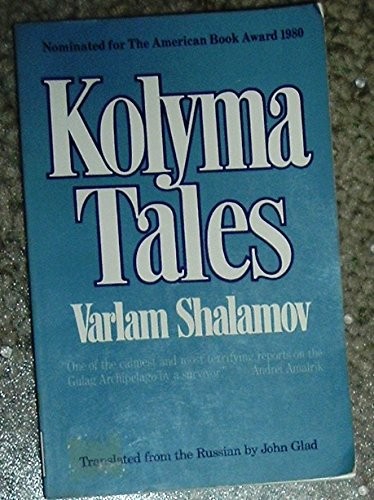
Kolyma Tales
Varlam Shalamov · 1907–1982 · Russia
Originally Kolymskie Rasskazy (Russian)
Why it matters
Seventeen years in the Arctic gold mines rendered without redemption or lesson: only the exact physics of a man reduced to hunger and frost. The Gulag's coldest, most uncompromising witness.
At a glance
Spare, flat prose is easy to parse sentence by sentence, but the cumulative bleakness is demanding.
Deep dive
Six years in the Kolyma gold-mining camps, rewritten as the plainest, least forgiving prose ever taken out of the Gulag: what Shalamov refuses to give the reader that Solzhenitsyn does.
Written for readers who have finished the book. No plot recap, and nothing here is safe to read first.
Themes & symbolism
Shalamov spent roughly seventeen years in the Kolyma camp system, and the stories he wrote afterward strip away nearly everything a reader might expect from camp literature: no arc of moral survival, no scene where suffering clarifies a man's soul, no character who emerges spiritually intact. In 'In the Night,' two prisoners dig up a freshly buried corpse to strip its clothes for barter, described in the same flat register Shalamov gives to weather or rations, because in Kolyma robbing the dead is simply one more task dictated by cold and hunger, not a moral event worth flinching at. 'Dry Rations' tracks a work brigade sent to a lighter outdoor assignment that starts to feel, absurdly, like a reprieve, until the story makes clear that 'lighter' in Kolyma still means men dying at a rate the camp barely bothers to record.
The cold itself functions as the collection's real antagonist, more consistent and more totalizing than any guard: at minus fifty degrees, Shalamov's prisoners stop being capable of friendship, memory, or reflection, reduced entirely to the physics of staying warm and getting the next ration, and he insists repeatedly, against the grain of most survivor literature, that this reduction was total and left nothing ennobling behind once a man had been in the camps long enough.
Written Against One Day in the Life of Ivan Denisovich
Shalamov and Solzhenitsyn corresponded and briefly considered collaborating, but Shalamov came to see One Day in the Life of Ivan Denisovich as dangerously wrong about what the camps actually did to people, its hero still capable of small satisfactions, a well-laid brick, a smuggled bit of sausage, within a single relatively survivable day. Shalamov's Kolyma, drawn from harsher gold-mining camps rather than Solzhenitsyn's labor camp, offered no such day; his stated ambition was a 'new prose' purged of literary consolation entirely, closer to a court transcript than a novel, because he believed any aesthetic pleasure taken in the telling was itself a kind of lie about what the material actually was.
A Body of Work Suppressed Until After Its Author's Death
Shalamov wrote the Kolyma stories across the 1950s and 1960s after his release and rehabilitation, but the KGB confiscated his archive in 1966 and the full cycle circulated only in samizdat and émigré editions for the rest of his life; broken by strokes and near-deafness, he died in a Moscow psychiatric institution in 1982 having seen only a handful of the stories published, and nothing like a complete Russian edition appeared until glasnost, years after his death.
Where to go next
 Isaac Babel · 1926Red CavalryLvl 5Fast paced
 Boris Pasternak · 1957Doctor ZhivagoLvl 6Slow burn
 Mikhail Sholokhov · 1928And Quiet Flows the DonLvl 5Medium pace
 Aleksandr Solzhenitsyn · 1962One Day in the Life of Ivan DenisovichLvl 3Fast paced
 Ivan Bunin · 1943Dark AvenuesLvl 4Medium pace
 Mikhail Lermontov · 1840A Hero of Our TimeLvl 4Medium pace