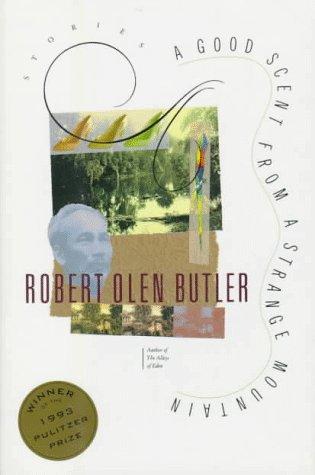
A Good Scent from a Strange Mountain
Robert Olen Butler · b. 1945 · USA
Why it matters
Vietnamese refugees rebuilding lives in Louisiana narrate their own displaced lives directly, story after story: an elderly loyalist to Ho Chi Minh, a woman convinced of her own reincarnation. Butler's Pulitzer-winning collection renders the Vietnam War's aftermath entirely from the exiled side.
At a glance
Clear first-person voices throughout, though the shifting narrators require attention story to story.
Deep dive
How a white American Vietnam veteran spent years teaching himself to write entirely from inside Vietnamese refugee voices, and what that risk earned him in Louisiana bayou country.
Written for readers who have finished the book. No plot recap, and nothing here is safe to read first.
Themes & symbolism
Butler, who served as a military intelligence officer fluent in Vietnamese during the war, narrates every story here in first person as a Vietnamese immigrant rebuilt into Louisiana, an unusual, sustained act of ventriloquism that the collection uses to insist Vietnam's aftermath belongs, first, to the people who were actually displaced by it. The title story gives an elderly former loyalist to Ho Chi Minh, now a widower in a Louisiana nursing home, conversations with his dead father's ghost that mix homesickness with a lifetime's political disillusionment, memory doing the work an American war narrative usually assigns to combat.
"Fairy Tale" follows a bar dancer from Saigon who talks her way to Louisiana through a string of American men, narrating her own hard-won survival with a wit that keeps refusing pity even as the facts of her situation earn it easily. "Snow" gives an elderly woman working a donut shop register an obsessive private devotion to The Sound of Music, watched so many times she's memorized it, a small American artifact she's turned into her own private vocabulary for homesickness and hope.
"Mid-Autumn" addresses an unborn child directly, a pregnant woman writing out her family's whole displaced history as a kind of inheritance letter, and that instinct, explaining Vietnam to someone who never lived it, runs under nearly every story here. Butler's collection insists refugee experience isn't a single story repeated with different names but a whole range of political loyalties, generations, and private obsessions that happen to share one uprooting.
Writing Across the Widest Possible Gap
A white American veteran narrating an entire book from inside Vietnamese refugee consciousness invites an obvious challenge, and Butler answers it less through claimed authority than through specificity: precise details of Confucian filial duty, particular songs, particular gods, particular grievances against particular political factions, rather than a generalized idea of displacement. The 1993 Pulitzer Prize the collection won suggests how persuasively that specificity read, though the book's real gamble is formal as much as ethical, first person, present tense, no American narrator standing between the reader and the voice.
Louisiana as an Accidental Vietnam
Butler sets almost every story in and around Lake Charles and New Orleans, where the actual postwar Vietnamese refugee community concentrated around fishing and shrimping industries that echoed the Mekong Delta's economy, and the collection treats that geography as more than coincidence. Bayou humidity, hurricane season, and a shared reliance on water for a living let his characters find genuine, unforced resonance with home rather than simple substitution, a new country that happens to rhyme with the one they lost.