
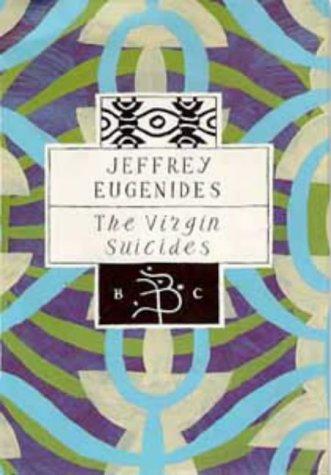
The Virgin Suicides
Jeffrey Eugenides · b. 1960 · United States
Why it matters
The neighborhood boys who once watched the five Lisbon sisters now, decades later, piece together why all of them died within a single year. Eugenides's eerie, collective-voiced debut novel of suburban myth-making.
At a glance
An unusual first-person-plural narrator sustained across the whole novel.
Deep dive
Why the neighborhood boys narrating this book, decades later, are still assembling exhibits instead of an explanation, and what the elm trees dying all over the block of Dutch elm disease are quietly keeping pace with.
Written for readers who have finished the book. No plot recap, and nothing here is safe to read first.
Themes & symbolism
Eugenides narrates entirely in first-person plural, a chorus of neighborhood boys, now middle-aged men, who have spent decades collecting physical evidence, photographs, a diary fragment, medical records, testimony from parents and teachers, trying to reconstruct why all five Lisbon sisters died within roughly a year. The collective 'we' is the novel's real subject: these men can catalog exhibits with forensic precision and still, after all this archival effort, understand nothing about the girls' interior lives, since the entire method was always about possessing an idea of the sisters rather than actually knowing them.
The Lisbon parents' response to Cecilia's first, near-fatal fall onto a fence spike, followed months later by her successful jump from her bedroom window during a party thrown specifically to cheer her up, is to tighten control rather than loosen it, pulling the remaining four daughters from school and eventually boarding up the house entirely. Eugenides uses that escalating confinement to indict a specific late-twentieth-century suburban instinct, that visible order and enforced safety can substitute for actual attention, and the neighborhood's parallel crisis, a Dutch elm disease epidemic quietly killing the street's trees one at a time despite the city's efforts to contain it, tracks the Lisbon house's decline with the same slow, procedural inevitability.
Trip Fontaine and the One Night the Boys Weren't Watching
Lux's brief, intense romance with Trip Fontaine, the school's most desired boy, culminates in homecoming night sex on the football field followed by Trip abandoning her there without a ride home, the single scene in the novel with a named, individual male actor rather than the anonymous collective narrator, and it reads as the sharpest available explanation for the total lockdown that follows. Eugenides lets this be the last real contact any outsider has with Lux's interior life, everything the neighborhood boys later construct about her drawn instead from secondhand report and their own projection, an interpretive gap the grown men narrating the book have never once managed to close.
The last seal: what actually happens, and why it lands the way it does.
The ending, explained
The four surviving sisters, after weeks of near-total isolation, begin signaling the neighborhood boys with lights and mixtape song titles played over the phone, and eventually invite a small group over late one night, language the boys read, wrongly, as an invitation to help them escape the house for good. Instead, the boys arrive to find Bonnie already hanged in the basement, and over the following minutes discover Mary, Therese, and Lux dead by overdose, gas, and carbon monoxide in the closed garage, a coordinated ending Eugenides gives no explanatory monologue or note adequate to it. The narrators close the book decades later exactly as unresolved as they began it, having mistaken the sisters' last message for rescue when it was, all along, a goodbye they were never equipped to read correctly.
Where to go next
 Jeffrey Eugenides · 2002MiddlesexLvl 6Medium pace
 Jonathan Franzen · 2001The CorrectionsLvl 6Medium pace
 Jhumpa Lahiri · 1999Interpreter of MaladiesLvl 3Medium pace
 Junot Díaz · 2007The Brief Wondrous Life of Oscar WaoLvl 7Fast paced
 Elena Ferrante · 2011My Brilliant FriendLvl 3Fast paced
 D. H. Lawrence · 1913Sons and LoversLvl 5Medium pace