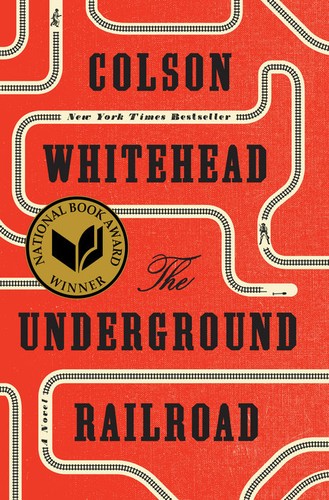
The Underground Railroad
Colson Whitehead · b. 1969 · United States
Why it matters
The metaphor made literal: a real subterranean train carries an escaped slave through a nightmare tour of America. Whitehead fuses history and allegory into a relentless engine, winning both the Pulitzer and the National Book Award.
At a glance
Clear prose carries a structurally inventive but easy-to-follow episodic journey.
Deep dive
Why literalizing the metaphor — an actual train under the soil — lets Whitehead turn every state Cora crosses into its own separate American nightmare.
Written for readers who have finished the book. No plot recap, and nothing here is safe to read first.
Themes & symbolism
Whitehead's founding move is to take the Underground Railroad's name literally — an actual steam engine on actual tracks, dug and engineered by nameless hands underground — and then use the device to break the novel out of linear geography altogether. Each state Cora surfaces into isn't the historical Georgia or South Carolina or North Carolina but an alternate-history distillation of a specific American strategy for managing Black life: South Carolina's smiling paternalism runs a covert eugenics and Tuskegee-style medical-experimentation program under the cover of 'uplift'; North Carolina has abolished slavery by abolishing Black residents entirely, lining its roads with lynched bodies and hiding the ones still living in attics, an American genocide staged with the visual grammar of Anne Frank's Amsterdam. The railroad's builders are never named or fully seen, and that anonymity is the point — the novel keeps insisting that resistance this vast had to have been collective and largely unrecorded, an infrastructure history simply didn't bother to write down.
Ridgeway, the slave catcher who has hunted Cora's mother Mabel and then Cora herself across the book, articulates something close to the novel's thesis about America as a project rather than a place: the 'American imperative,' he calls it, the drive to take, clear, and improve, with slavery simply one expression of a logic that also produced the railroad, the frontier, and Indiana's stolen land. His failure to catch Mabel gnaws at him specifically because it's the one time the imperative didn't complete itself, which makes Cora's capture less a professional obligation than an old wound he's still trying to close. The reveal that Mabel didn't abandon Cora for freedom but died in the swamp trying to make her way back — turned around by heartbreak and a snakebite before she could ever face what she'd left — recasts the entire novel's founding trauma: the mother Cora spent the book resenting for escaping never actually managed to.
A State-by-State American Anthology
The novel's structure — Cora surfacing into a new, self-contained horror with each state line, book-ended by short biographical chapters on side characters like Ridgeway, Ethel, and Caesar — gives it the fragmented, documentary rhythm of an anthology rather than a single continuous escape narrative. Tennessee's fire-scorched, plague-ridden landscape reads as biblical punishment; Indiana's Valentine Farm, a thriving Black-owned community, stages a real historical debate between Black separatism and integrationist uplift before a white mob burns it to the ground — Whitehead moving the clock forward and backward across a century of American racial strategy while keeping Cora fixed in what still reads as a single continuous flight.
What the Attic Really Holds
Cora's months hidden in Martin and Ethel's crawlspace, watching North Carolina's public square through a crack in the wall while the town parades captured runaways and free Black corpses for entertainment, is the novel's most explicit citation of Holocaust literature layered onto American slavery — the attic, the informer neighbors, the constant listening for footsteps on the stairs. Whitehead isn't drawing the parallel to flatten either atrocity into the other; he's insisting that genocide is a repeatable technology, not a single historical event, and that America ran a version of it in plain sight.
The last seal: what actually happens, and why it lands the way it does.
The ending, explained
After the Valentine Farm community is destroyed in a white mob's raid — Valentine, Royal, and others killed — Ridgeway captures Cora once more and forces her down into the tunnel to show her, one last time, where the railroad ends. In the struggle at the shaft, Cora manages to pull him down with her; he's badly hurt in the fall, and she leaves him trapped below and walks the tunnel alone for days until she finds a hatch to the surface. Aboveground, exhausted and half-starved, she's found by an old Black man named Ollie, driving a wagon west, who offers her a ride and asks where she's headed and what her story is. The novel ends without putting an answer on the page — Cora, for the first time, gets to decide what of her own history she's willing to hand over, riding out into a country Whitehead leaves deliberately unmapped and ongoing.