
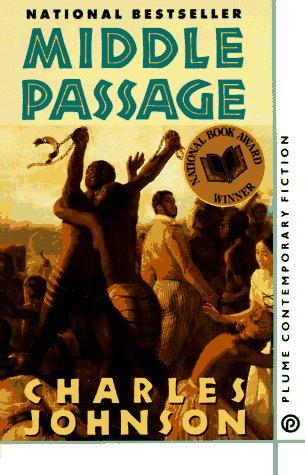
Middle Passage
Charles Johnson · b. 1948 · United States
Why it matters
A newly freed con man stows away on a slave ship, only to become witness and near-victim of the Middle Passage's horror. Johnson's National Book Award winner fuses picaresque adventure with unflinching philosophical reckoning.
At a glance
Dense philosophical digression is folded into a fast-moving adventure plot.
Deep dive
How a Melville pastiche becomes a Buddhist meditation on selfhood, and why the novel's real monster isn't Falcon.
Written for readers who have finished the book. No plot recap, and nothing here is safe to read first.
Themes & symbolism
Johnson builds Rutherford as a philosophical problem before he's a character: a man who has stolen his way through life precisely because he's never believed in a stable self worth being loyal to. That's why the crossing works on him the way it doesn't on anyone else aboard. The Allmuseri, by contrast, are Johnson's invented rebuke to Western individualism — a people whose language reportedly has no separate words for 'self' and 'other,' whose culture is bound so tightly that slavery doesn't just brutalize them, it makes a category error of them. The god in the hold is the novel's answer to what happens when that unity is forced into a cage: when it's released, it doesn't attack anyone. It simply reflects each viewer's own nature back at them, and that's what breaks the crew — not violence but recognition. Falcon, the dwarfish captain, is Johnson's cartoon of imperial will: a man who has spent his life trying to master everything outward precisely because he can't tolerate anything unmastered within himself, and his death at the moment of mutiny reads less like justice than like the universe correcting an equation.
The Republic itself is the novel's cruelest joke — a slave ship named for the nation's founding ideal, crewed by men who are themselves debtors, castoffs, and prisoners of a kind, ferrying a cargo of people whose captivity exposes exactly what that 'republic' was built to not-see. Rutherford's diary-keeping (the novel's frame device) mimics the sea-narrative and slave-narrative traditions at once, and the joke is that his testimony starts out as pure self-interest and ends up as the only kind of witness that matters.
Melville, and the debt to Benito Cereno
Johnson is writing directly against — and into — Melville's Benito Cereno, another sea tale built on a hidden slave mutiny and a white narrator too blinkered by his own assumptions to see the truth in front of him. But where Melville's Delano remains obtuse to the end, Johnson gives Rutherford the one thing Delano never gets: transformation. Rutherford starts the novel unable to commit to anything, including Isadora, and ends it having watched unity and atrocity at such close range that flight itself has lost its appeal. Johnson, a practicing Buddhist and philosophy scholar as well as a novelist, is using the picaresque's episodic freedom — one of the oldest forms for a rogue's escape from consequence — to stage its opposite: a con man who finally stops running.
The last seal: what actually happens, and why it lands the way it does.
The ending, explained
The Republic, gutted by mutiny and storm alike, finally sinks; Rutherford and a handful of survivors are picked up by a passing ship whose captain turns out to be Jackson Calhoun, Rutherford's own estranged, deeply respectable brother — a coincidence so large it announces itself as fable rather than plot mechanics. It's Johnson's way of insisting that the family and community Rutherford spent the novel fleeing were waiting for him all along, on the other side of the worst thing he could witness. Back in New Orleans, Rutherford proposes to Isadora Bailey, the schoolteacher whose respectability he'd found suffocating at the novel's start. It isn't a romantic capitulation; it's the con man finally accepting that a self worth being responsible for is a self worth binding to another person.
Where to go next
 Percival Everett · 2001ErasureLvl 6Fast paced
 Ralph Ellison · 1952Invisible ManLvl 7Medium pace
 Michael Chabon · 2000The Amazing Adventures of Kavalier and ClayLvl 5Fast paced
 Richard Powers · 2018The OverstoryLvl 7Slow burn
 Paul Harding · 2009TinkersLvl 6Slow burn
 Colson Whitehead · 2016The Underground RailroadLvl 5Fast paced