
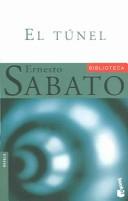
The Tunnel
Ernesto Sabato · 1911–2011 · Argentina
Originally El túnel (Spanish)
Why it matters
A painter confesses, from prison, the obsessive jealousy that drove him to murder the one woman who understood his work. Existentialist dread compressed into a short, airless, unforgettable novel.
At a glance
A tight, obsessive first-person confession compresses dread into under 150 pages.
Deep dive
A painter narrates his own crime from prison in flat, methodical prose — and the analytical question isn't what he did, it's why he needed to believe one woman could rescue him from being alone in his own head.
Written for readers who have finished the book. No plot recap, and nothing here is safe to read first.
Themes & symbolism
The title's tunnel is Sabato's central image for consciousness itself: Castel experiences other people as sealed off in their own parallel passages, occasionally seeming to run alongside his own, until the illusion of connection collapses and he's left as isolated as before. What triggers his fixation on María isn't love in any ordinary sense — it's that she alone, in a crowd viewing one of his paintings, paused before a small, marginal detail (a tiny window and a distant, solitary woman) that no other viewer had noticed, and he decides on the strength of that single unverifiable moment that she is the one person capable of truly seeing him. Everything that follows is Castel testing that belief against reality and demanding, with escalating paranoia, that reality keep confirming it.
Sabato's real subject is solipsism dressed up as romantic intensity: Castel doesn't investigate who María actually is — a married woman with a blind husband, a complicated cousin, a life independent of him — he interrogates her, spies on her, and punishes every sign that she has an existence outside the meaning he's assigned her. The murder that closes the novel isn't a rupture in his character so much as its logical terminus: if another person is only real to you insofar as they confirm your own private meaning, then the moment they assert an interior life of their own becomes intolerable, and violence becomes, in Castel's twisted arithmetic, the only way left to make the tunnel connect.
From Physics to Fiction: Sabato's Break with Reason
Sabato trained as a physicist, earned a doctorate, and worked briefly at the Joliot-Curie laboratory in Paris before abandoning a promising scientific career in the early 1940s out of a growing conviction that scientific rationalism had produced a dehumanized, abstracted way of seeing the world — a disillusionment sharpened by watching physics feed directly into the era's new machinery of mass death. That biography sits just under the surface of The Tunnel: Castel is a painter whose work is drifting toward cold geometric abstraction even as he craves the one human, irrational connection that might rescue him from it, and his jealous, obsessive reasoning throughout the novel is presented as a kind of perverted rigor — logic and method turned to entirely irrational, destructive ends. Sabato spent the rest of his career arguing, in essays and later novels, that pure rationalism, unchecked by the irrational and the ethical, curdles into exactly this kind of violence.
The last seal: what actually happens, and why it lands the way it does.
The ending, explained
Convinced that María belongs, in some final and intolerable sense, to her cousin Hunter rather than to him, Castel drives out to Hunter's country estate and, in a fit of possessive rage, stabs María to death. The confession that frames the whole novel is written after the fact, from prison, and it's strikingly flat — self-justifying and methodical rather than remorseful, because Castel's real subject, even in confessing, is still himself: he's less interested in atoning for María's death than in proving, one final time, that his reading of events was correct. That refusal of remorse is the novel's last and bleakest joke: the murder was never really about María at all, and killing her doesn't break Castel out of his tunnel — it just proves, permanently, that he was never able to get out of it.
Where to go next
 Ernesto Sabato · 1961On Heroes and TombsLvl 8Slow burn
 Fyodor Dostoevsky · 1866Crime and PunishmentLvl 6Fast paced
 Roberto Arlt · 1929The Seven MadmenLvl 7Medium pace
 Miguel de Unamuno · 1914MistLvl 6Medium pace
 Ralph Ellison · 1952Invisible ManLvl 7Medium pace
 Juan Carlos Onetti · 1950A Brief LifeLvl 8Slow burn