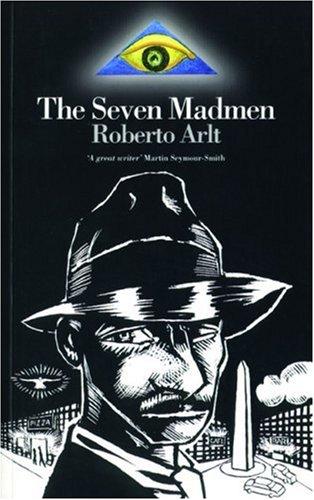
The Seven Madmen
Roberto Arlt · 1900–1942 · Argentina
Originally Los siete locos (Spanish)
Why it matters
An embezzling Buenos Aires clerk falls in with a lunatic 'Astrologer' plotting to fund a fascist revolution through a syndicate of brothels and a poison-gas patent. A feverish, paranoid vision of the modern city as a half-built machine about to seize.
At a glance
Deliberately clumsy, breathless prose and a cast of conspirators and cranks resist a clean throughline.
Deep dive
A broke, embezzling clerk falls in with a self-styled revolutionary prophet — and the novel that results is less interested in whether the conspiracy is real than in what kind of city produces men desperate enough to believe in it.
Written for readers who have finished the book. No plot recap, and nothing here is safe to read first.
Themes & symbolism
Remo Erdosain is introduced already caught, or nearly caught, in a petty embezzlement he can't cover, and Arlt uses that unglamorous crisis to open onto something much larger: a portrait of Buenos Aires as a half-built, dehumanizing machine that produces failed inventors, failed romantics, and failed revolutionaries in roughly equal measure. Erdosain's own tinkering with hopeless inventions is the novel's clearest symbol for a whole class of modern men who've absorbed the promise of rational, technological progress without ever getting access to its actual rewards, left instead with grandiose ideas and no capital, no standing, no way to make them real.
The Astrologer, who recruits Erdosain into a scheme to fund a coming revolution through a syndicate of brothels and a poison-gas patent, is the novel's engine of ambiguity: Arlt deliberately keeps it unclear how much of the conspiracy is a genuine, financed plan and how much is grandiose theater performed for an audience of equally desperate men who need to believe in something bigger than their own humiliation. That refusal to resolve fantasy from reality is the point — the novel reads the appeal of authoritarian, quasi-fascist myth-making as a symptom of exactly the alienation and failure it diagnoses in Erdosain, a warning about how paranoid, half-believed political fantasy takes root in men with nothing left to lose.
A Pulp Journalist Who Rewired Argentine Fiction
Arlt was a self-taught son of immigrants who earned his living as a newspaper columnist, writing the enormously popular Aguafuertes porteñas ('Buenos Aires etchings') for El Mundo, and he wrote fast, unpolished, plot-hungry prose that the era's refined literary establishment — the circle around Borges and the journal Sur — largely looked down on as vulgar. That outsider status is inseparable from what makes The Seven Madmen still feel alive: it has none of the period's ornamental elegance and all of its nervous, feverish energy, closer to Dostoevsky (whose influence Arlt acknowledged directly, and whose Raskolnikov-like moral disintegration Erdosain clearly descends from) than to anything in the polite Argentine tradition around him.
That roughness is exactly why later writers reclaimed him as a founding figure instead of a minor one: Ricardo Piglia built a body of criticism and fiction directly in dialogue with Arlt, and Roberto Bolaño repeatedly named him among the writers he admired most, prizing precisely the paranoid, unfinished, high-pressure quality that the Borges tradition had dismissed. The Seven Madmen's reputation has only grown as a result — read today as the true origin point for a whole strain of Latin American fiction obsessed with conspiracy, failure, and cities that seem to be quietly building toward their own catastrophe.
The last seal: what actually happens, and why it lands the way it does.
The ending, explained
Arlt wrote The Seven Madmen with its plot deliberately left open, and that's by design rather than accident: the novel was published alongside a direct sequel, Los lanzallamas (The Flamethrowers), written to continue and eventually resolve the conspiracy's threads, so the first book closes on escalation rather than resolution. Erdosain's moral disintegration deepens throughout — his implication in the group's increasingly desperate, ethically compromised schemes leaves him further from any way back to an ordinary life — but the Astrologer's actual revolution never arrives on the page, and the novel declines to say how much of it was ever real. That unresolved, paranoid suspension is the point: The Seven Madmen isn't building toward a climax so much as documenting the exact pitch of delusion and desperation a city can produce in a man right before something breaks.