
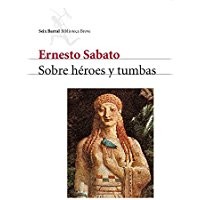
On Heroes and Tombs
Ernesto Sabato · 1911–2011 · Argentina
Originally Sobre héroes y tumbas (Spanish) · translated by Helen Lane
Why it matters
A young man's obsessive love collides with his lover's family's buried secrets, opening onto a hallucinatory 'Report on the Blind' that reads like a novel within the novel. Sabato's masterpiece: existentialist dread at its fullest scale.
At a glance
A hallucinatory embedded novella interrupts and destabilizes the main plot's already dense structure.
Deep dive
Why Sábato opens with a shocking newspaper clipping about a young woman and her father, then spends four hundred pages working backward through a paranoid tract about a secret society of blind men to explain what actually happened between them.
Written for readers who have finished the book. No plot recap, and nothing here is safe to read first.
Themes & symbolism
Sábato frames the entire novel around Alejandra Vidal Olmos, the last daughter of a once-grand, now decaying aristocratic family whose ancestral home, the Mirador, still stands as a monument to a national mythology, heroism, sacrifice, old Argentine nobility, that has curdled into paralysis and rot by the twentieth century. Martín del Castillo, the working-class young man who falls for Alejandra, functions as the novel's outside observer, drawn deeper into the Vidal Olmos family's decay without ever fully understanding what he's looking at, which lets Sábato use him as the reader's own limited vantage point on a family history far darker than Martín, or most readers, can initially imagine.
"Report on the Blind," the paranoid, hallucinatory section narrated by Alejandra's father Fernando, breaks from the rest of the novel's relatively conventional realism to detail his investigation into a secret sect of blind people he believes secretly controls the world's hidden machinery of evil, and whether Fernando's account is delusion, genuine occult conspiracy, or some psychologically coherent third thing is a question Sábato refuses to settle. What the section makes undeniable is the household Alejandra actually grew up in, one organized entirely around her father's escalating paranoia and, the novel eventually confirms, his incestuous claim on his own daughter.
The historical Alejandra, a nineteenth century ancestor whose story runs parallel to the contemporary plot through Argentina's civil wars between Unitarians and Federalists, gives Sábato his title's other half, the heroes and tombs of a national mythology the present-day Vidal Olmos family can only inherit as rot rather than glory. Buenos Aires itself, sketched across the novel in exacting, disenchanted detail, becomes the site where that inherited grandeur and its contemporary decay sit directly on top of each other.
A Novel Sábato Built on a Real Crime
Sábato based the novel's opening frame, and its ending, on an actual 1953 case in Buenos Aires in which a young woman was found to have killed her father and set fire to the room they died in together, a crime that shocked the city precisely because no public account of the family's private life could explain it. Sábato's decision to build four hundred pages of psychological, historical, and philosophical scaffolding underneath that single unexplained newspaper item reframes tabloid violence as the visible tip of exactly the kind of buried, generational corruption most crime reporting has no vocabulary for.
The last seal: what actually happens, and why it lands the way it does.
The ending, explained
The novel's opening frame is completed rather than reversed by its final pages: Alejandra locks herself and her father Fernando inside the Mirador, shoots him four times, then douses the tower in gasoline and sets it burning around both of their bodies, an act the narrative has been building toward since the first chapter's newspaper clipping without ever letting the reader feel it as inevitable rather than devastating. Sábato frames the killing as Alejandra's only available exit from an incestuous, psychologically annihilating relationship her father had trapped her in since childhood, violence turned finally outward after a lifetime of being turned in on herself. Martín, the one character who loved Alejandra without trying to possess or explain her, survives into the novel's final chapter to carry the unresolved weight of a national and family history he was only ever allowed to witness from its edge.
Where to go next
 Ernesto Sabato · 1948The TunnelLvl 5Fast paced
 Fyodor Dostoevsky · 1866Crime and PunishmentLvl 6Fast paced
 Roberto Arlt · 1929The Seven MadmenLvl 7Medium pace
 Miguel de Unamuno · 1914MistLvl 6Medium pace
 Ralph Ellison · 1952Invisible ManLvl 7Medium pace
 Juan Carlos Onetti · 1950A Brief LifeLvl 8Slow burn