
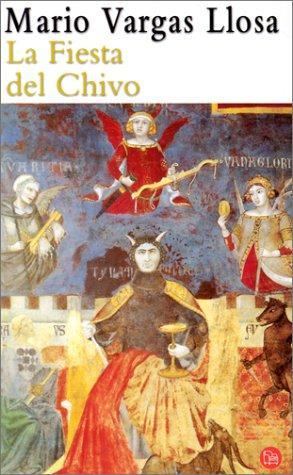
The Feast of the Goat
Mario Vargas Llosa · 1936–2025 · Peru
Originally La Fiesta del Chivo (Spanish) · translated by Edith Grossman
Why it matters
Trujillo's last day, his assassins' wait, and a woman's return to Santo Domingo decades later. The dictator novel perfected late: power's machinery and its intimate damage in relentless triple focus.
At a glance
A triple-stranded structure alternates decades and perspectives around a dictatorship's fall.
Deep dive
A woman returns to Santo Domingo after decades away, and the reason she left, and the last day of Rafael Trujillo's rule, unfold side by side until the two stories turn out to be one story her family has spent thirty-five years refusing to say out loud.
Written for readers who have finished the book. No plot recap, and nothing here is safe to read first.
Themes & symbolism
Vargas Llosa braids three timelines: Urania Cabral's 1996 return to the Dominican Republic to confront her elderly, silent father, Agustín Cabral, a once-powerful Trujillo loyalist; a group of conspirators waiting in a parked car on the night of May 30, 1961, to assassinate Trujillo; and Trujillo himself moving through what will turn out to be his final day in office, attended to by a regime built entirely around his personal whims, his obsession with cleanliness, his fixation on his own failing body, his casual command over which of his ministers' wives and daughters he will summon next. The three strands don't simply alternate for structural variety. They accumulate toward a single unstated fact the novel makes readers wait for and dread, since Urania's reason for staying away for thirty-five years and the specific violence of Trujillo's regime are, by the book's design, always going to turn out to be the same thing.
Trujillo's rule depended on total, theatrical submission from the men around him, and Vargas Llosa's Agustín Cabral is the novel's clearest specimen of what that submission costs: a father who, sensing he's fallen from favor, offers his own fourteen-year-old daughter to the aging dictator as a gift meant to restore his standing. Urania's long, precise account of what happened to her that night, delivered to relatives who have spent decades avoiding the subject entirely, functions as the novel's real climax far more than the assassination itself, since Vargas Llosa's deepest interest is in how a society organizes collective silence around exactly the crimes its ruling structure required.
A Fictional Reckoning with a Regime Still Recent
Trujillo ruled the Dominican Republic for over three decades until his assassination in 1961, and Vargas Llosa researched the regime extensively, interviewing survivors and conspirators' relatives, before writing a novel that names real historical figures, Trujillo, his son Ramfis, the plotters Antonio Imbert and Amadeo García Guerrero, alongside invented characters like Urania and her father. That mix provoked controversy in the Dominican Republic on publication, some readers objecting to a Peruvian outsider claiming authority over their national trauma, but the novel's unflinching detail about Trujillo's cult of personality, down to his uniforms, his household rituals, and his sexual predation as an instrument of political control, has become one of the dictator novel genre's most widely read and most frequently assigned entries.
The last seal: what actually happens, and why it lands the way it does.
The ending, explained
The assassins succeed in killing Trujillo on the road outside the capital, but the plot immediately unravels: expected military support fails to materialize, and Trujillo's son Ramfis returns to hunt down and torture nearly every conspirator he can find, most of them executed after prolonged brutality, with only a few escaping into hiding or exile. The dictatorship doesn't end cleanly with the dictator's death, since Ramfis and the surviving Trujillista apparatus cling to power for months afterward before the family's grip finally breaks. Urania, in the present, finishes telling her cousins exactly what her father allowed to happen to her, and the novel ends with that confession changing nothing structurally, Trujillo has already been dead for decades by 1996, but finally breaking a family silence that had outlasted the regime itself by over three decades.
Where to go next
 Mario Vargas Llosa · 1963The Time of the HeroLvl 6Medium pace
 Mario Vargas Llosa · 1966The Green HouseLvl 8Slow burn
 Mario Vargas Llosa · 1969Conversation in The CathedralLvl 9Slow burn
 Mario Vargas Llosa · 1977Aunt Julia and the ScriptwriterLvl 4Fast paced
 Mario Vargas Llosa · 1981The War of the End of the WorldLvl 7Medium pace
 Carlos Fuentes · 1962The Death of Artemio CruzLvl 8Slow burn