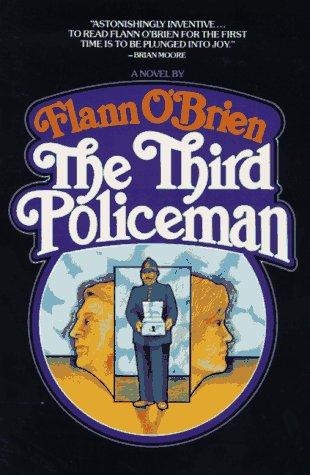
The Third Policeman
Flann O'Brien · 1911–1966 · Ireland
Why it matters
A nameless murderer wanders a rural Ireland where bicycles and men swap souls and policemen expound mad physics, before discovering the true shape of his own fate. O'Brien's posthumous masterpiece of comic metaphysics.
At a glance
Absurdist logic and digressive pseudo-scholarly footnotes disrupt straightforward reading.
Deep dive
A nameless narrator and an accomplice rob and dispose of an old neighbor, then can't find what they were after, and O'Brien turns the search for it into a country policed by men obsessed with bicycles and a philosopher whose footnotes threaten to swallow the book whole.
Written for readers who have finished the book. No plot recap, and nothing here is safe to read first.
Themes & symbolism
The narrator's crime, killing old Phillip Mathers for the cashbox his own partner John Divney insists is hidden in Mathers's house, sets the plot moving and then almost stops mattering: once the narrator returns years later to dig up the buried box, the novel abandons conventional cause and effect for a country policed by Sergeant Pluck and Policeman MacCruiskeen, whose interrogations run entirely on nonsense logic delivered with total institutional confidence. O'Brien keeps the crime as backstory rather than plot engine, letting its consequences surface only obliquely, in Mathers's unexplained continued presence in the narrative and the reader's slow, uneasy sense that something about the narrator's own status in this world doesn't add up.
Sergeant Pluck's theory that bicycle riders and their bicycles gradually exchange atoms, so that a man who rides enough becomes more than half bicycle while his bicycle becomes correspondingly human, is O'Brien's most purely comic invention and also his clearest satire of materialist explanation taken to its logical, deranged extreme: a police force that investigates everything except the actual crime, applying rigorous, absurd method to entirely the wrong questions. The footnotes on the fictional philosopher de Selby, whose crackpot theories, night as an accumulation of black air, houses avoidable by traveling in a circle around them, accumulate through increasingly elaborate scholarly apparatus and academic feuds, run a parallel joke about the whole apparatus of intellectual authority, expertise performed with total confidence about a world it has completely misread.
Eternity Under a Trapdoor
MacCruiskeen takes the narrator down a lift to an underground chamber the policemen call Eternity, where any object can be duplicated infinitely by turning dials, gold, food, anything the narrator names, and O'Brien uses the scene to stage pure wish fulfillment as a kind of horror rather than a reward: the narrator's own attempt to smuggle gold back to the surface fails in ways the book never fully explains, and the chamber's frictionless abundance turns out to be exactly as meaningless as the buried cashbox that started the plot. Desire satisfied without limit, the scene suggests, is no more satisfying than desire endlessly deferred, which is the joke the whole novel has been building toward from its first page.
The last seal: what actually happens, and why it lands the way it does.
The ending, explained
The narrator finally reaches Mathers's house and the buried box, only to discover, through a series of details the novel has been quietly seeding since its opening pages, that he never left it: the explosion that killed him at the very start, planted by Divney inside the cashbox as a trap, happened before the story's events rather than after them, and everything since, the police station, Sergeant Pluck, MacCruiskeen, Eternity, has been the narrator's own afterlife, a bureaucratic hell built from Irish country policing and bicycle theory rather than fire. The novel's final pages loop the narrator back to the beginning of his own story with no memory of having lived it before, walking once again toward Divney's house to ask about the box, a closed circuit O'Brien presents as the actual shape of damnation: not punishment inflicted once, but the same absurd day arriving forever.