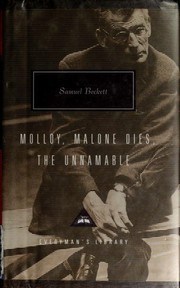
Molloy
Samuel Beckett · 1906–1989 · Ireland / France
Originally Molloy (French)
Why it matters
Two crawling quests (a vagrant seeking his mother, an agent seeking the vagrant) dissolving into pure voice. The first of the Trilogy and the purest dose of Beckett's comic desolation: the novel reduced to 'I can't go on, I'll go on.'
At a glance
Long unbroken paragraphs and a deliberately unreliable, self-canceling narrative voice.
Deep dive
Both halves end the same way: an authority collapses into the very incoherence it set out to observe or contain.
Written for readers who have finished the book. No plot recap, and nothing here is safe to read first.
Themes & symbolism
Beckett builds Molloy's half of the novel entirely out of a narrating voice that keeps undoing itself — sentences that assert something and then immediately qualify, retract, or admit total ignorance of why they were said at all, so the reader experiences the dissolution of a coherent self as a formal property of the prose rather than a plot point. Molloy's physical collapse, walking, then cycling, then reduced to crawling, proceeds in lockstep with the collapse of his own account's coherence, until the grand, almost mythic frame of the quest — a son returning to his dying or already-dead mother — is left standing over a narrator who can no longer say with confidence why he set out, what happened along the way, or whether any of what he has just told us is true.
Part two mirrors this from the opposite direction. Moran begins as everything Molloy is not — rigid, controlling, contemptuous of his own son, confident in his employer Youdi's authority and his own competence as an agent — and Beckett spends the section methodically stripping that composure away: his knee stiffens exactly as Molloy's legs failed, his son abandons him, his sentences begin performing the same digressive unraveling Molloy's did, until the hunter sent to find and report on the vagrant ends the novel almost indistinguishable from him in condition and voice. The double structure makes its point by refusing to let pursuit and quarry stay separate roles. Youdi himself is never seen and barely explained, reached only through the intermediary Gaber, and that unaccountable chain of command gives Moran's half of the book the same texture as Molloy's obscure obligation to his mother: neither man ever gets to examine the authority that set him moving, only obey it until obeying it destroys him.
The Sucking Stones
The novel's funniest and most representative passage has nothing to do with the mother-quest at all: Molloy spends several pages working out, with obsessive rational precision, how to distribute sixteen sucking stones among four pockets so that he sucks each stone exactly once before repeating any — a fully engineered system of rotation applied to a problem that could not matter less. It is Beckett's method in miniature: a rigorous, almost mathematical intelligence turned loose on a task whose triviality is the entire joke, and the gap between the effort and the object is where the trilogy's particular comedy, desolate, exact, very funny, actually lives.
Molloy is only the first turn of that screw. Beckett will spend Malone Dies further stripping away plot and setting until almost nothing remains but a dying man inventing stories to pass the time, and The Unnamable further still, until even a stable narrating voice is gone and the trilogy ends in pure, unattributable speech. Read from that vantage, Molloy's crawling narrator and Moran's collapsing agent are not an endpoint but a starting condition — the last novel in the sequence still willing to offer characters, names, and a quest, however hollowed out, before Beckett abandons even those.
The last seal: what actually happens, and why it lands the way it does.
The ending, explained
Moran's account ends by quoting the order he claims to have received to write the very report we have just read, and that report's opening line, "It is midnight. The rain is beating on the windows," is immediately followed by Moran's flat admission: "It was not midnight. It was not raining." The contradiction cancels the narrative's own opening in its final sentence, looping the novel back on itself rather than resolving forward, and formally enacts what both halves have been arguing all along: that neither Molloy nor Moran can be trusted to have told us anything straight, and the report was never more than another unstable performance of a self that could not hold together long enough to finish it honestly.