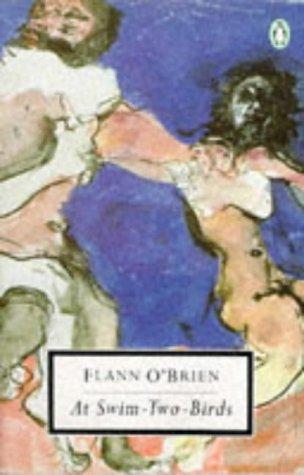
At Swim-Two-Birds
Flann O'Brien · 1911–1966 · Ireland
Why it matters
A student's novel nests inside a novel inside Irish mythology, its characters eventually rebelling against the author writing them. Metafiction decades ahead of its time, and one of Irish comic fiction's essential texts.
At a glance
Nested stories-within-stories and rebelling characters fracture any single narrative line.
Deep dive
How many layers of authorship a bored Dublin student can stack before the characters start writing back, and what happens when a novelist tries to rule his own inventions like a tyrant.
Written for readers who have finished the book. No plot recap, and nothing here is safe to read first.
Themes & symbolism
O'Brien's nested structure is the joke and the argument at once: an unnamed student is writing a novel about Dermot Trellis, a lazy hack novelist who is himself writing a novel, populating it with characters born fully adult through "Aestho-Autogamy" so he can skip the tedium of childhood and get straight to using them. Trellis's cruelty is structural rather than incidental — he keeps his characters frozen mid-scene between writing sessions, drugs one into a permanent stupor, and rapes his own creation Sheila to produce a son, Orlick, purely because the plot required it. The book's real target is authorial power itself: what does a novelist owe the people he invents, and what happens when the fiction stops being willing to absorb the abuse.
Into this frame O'Brien pours pastiche cowboys, Dublin low-life, and — most audaciously — long, straight-faced passages lifted and refracted from the real medieval Irish text Buile Suibhne, recounting the mad King Sweeny's transformation into a bird-man cursed to live in trees. Mixing scripture-grade myth with pulp Western dialogue and pub philosophy in the same register is the novel's comic thesis: all texts are equally raw material, hierarchy between "serious" literature and junk is an illusion, and any story can be interrupted, quoted, or cannibalized by any other.
Sweeny, Pastiche, and the Refusal of a Single Story
The frame narrator warns early on that a good book may have three openings and a hundred endings, and the novel makes good on it, refusing to settle into one plot or one tone for more than a few pages. Sweeny's mythic suffering, recited in the high style of the original text, sits directly beside cowboy shootouts and Fairy King farce, less a satire of Irish mythology than a demonstration that myth, once it's on the page, is just another kind of material waiting to be repurposed — exactly what Trellis is doing to his own characters, and exactly what the student-narrator is doing to Trellis.
The last seal: what actually happens, and why it lands the way it does.
The ending, explained
Trellis's characters, tired of being abused for his plot's convenience, put him on trial in a manuscript of their own and torture him at length for his cruelty — real payback, staged with the same deadpan solemnity as any court scene — only for Trellis's maid to burn his manuscript pages by accident while tidying, which erases the trial, restores Trellis's authority, and undoes the characters' rebellion entirely. At the exact same moment, the outer frame resolves too: the student's uncle, who has spent the novel disapproving of his idleness, relents on hearing he's passed his exams. The joke lands on every level at once — an author's control turns out to be as fragile as a sheaf of paper near a fire, and the closest thing to justice the characters get is erased by a domestic accident nobody even notices.