
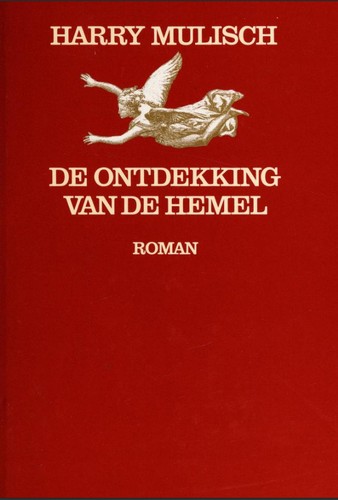
The Discovery of Heaven
Harry Mulisch · 1927–2010 · Netherlands
Originally De ontdekking van de hemel (Dutch)
Why it matters
A decades-long friendship between two men, framed by a cosmic dialogue about a divine mission to reclaim the tablets of the Ten Commandments. Mulisch's monumental late novel fuses realism with metaphysical scale.
At a glance
A long dual narrative braiding realist plot with cosmic framing.
Deep dive
What two angelic bureaucrats are actually negotiating above the heads of two lifelong friends, and why the novel needs an entire hidden architecture of coincidence to make its point.
Written for readers who have finished the book. No plot recap, and nothing here is safe to read first.
Themes & symbolism
Heaven's decision to recall its covenant with humanity — the literal tablets of the Ten Commandments — reframes the entire human plot of friendship, love, and parenthood as unknowing material for a design none of the characters ever perceive, letting Mulisch dramatize free will as either compatible with, or indistinguishable from, total predetermination: every apparently free choice Max, Onno, and Ada make is simultaneously an autonomous human decision and a gear turning in a plan set generations earlier. Quinten — raised believing Onno his father while Max is his biological one — becomes the point where secrecy at the human level (a hidden paternity) mirrors secrecy at the cosmic level (a hidden plan), doubling the dramatic irony that both the boy and the reader are kept from the truth of.
Max's astronomy and Onno's philology stand for two rival methods of approaching a truth beyond the human — one reads the physical universe, the other reads texts and the meanings humans layer onto them — and their decades-long friendship stages an implicit argument about which faculty gets closer to the transcendent, before the novel literalizes the question entirely by having heaven decide the covenant needs recalling regardless of what either method ever discovers.
Mulisch's Divided Inheritance
Mulisch was born in 1927 to an Austrian father who worked for German banking interests during the wartime occupation of the Netherlands, and a Dutch-Jewish mother whose own family did not survive the Holocaust — a paradox he described, with characteristic provocation, as making him, in effect, both the child of the war's perpetrators and its victims at once. That irreducible doubleness recurs across his work as an obsession with inherited guilt, paradox, and vast historical or metaphysical schemes that dwarf individual intention. The Discovery of Heaven, his late, most ambitious novel, is the largest expression of that preoccupation: an entire human generation's private choices serving a plan decided somewhere far above and beyond them, much as Mulisch experienced his own existence as an accident of geopolitical machinery he'd had no hand in. Dutch readers have repeatedly voted it the best Dutch novel of the twentieth century, and it was adapted into a 2001 film.
The last seal: what actually happens, and why it lands the way it does.
The ending, explained
As an adult, Quinten — guided since childhood by inclinations and dreams he doesn't fully understand, and by knowledge assembled piecemeal by the adults around him without any of them grasping the whole picture — travels to Rome, where a chain of engineered coincidences he experiences as his own initiative leads him through the Vatican archives to the tablets themselves. He retrieves them, and the covenant between God and humanity is formally, quietly dissolved: heaven has decided, the framing dialogue reveals, that direct divine involvement should end. The ending is bittersweet by design — humanity is left cosmically alone, severed from a heaven actively withdrawing rather than merely silent — but the novel frames that abandonment as also a species finally freed of a supervision it never fully knew it was under.
Where to go next
 Harry Mulisch · 1982The AssaultLvl 4Medium pace
 Cees Nooteboom · 1980RitualsLvl 6Slow burn
 Hugo Claus · 1983The Sorrow of BelgiumLvl 6Medium pace
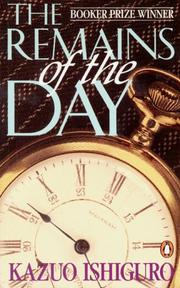 Kazuo Ishiguro · 1989The Remains of the DayLvl 5Slow burn
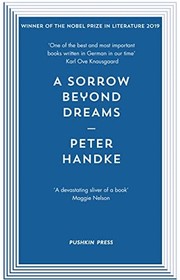 Peter Handke · 1972A Sorrow Beyond DreamsLvl 6Slow burn
 D. H. Lawrence · 1913Sons and LoversLvl 5Medium pace