
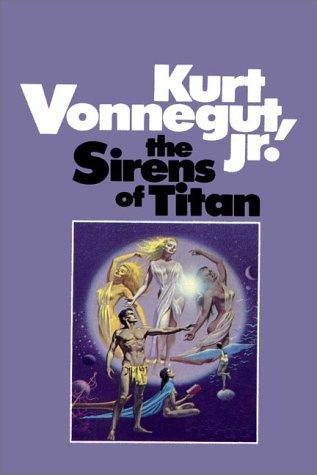
The Sirens of Titan
Kurt Vonnegut · 1922–2007 · USA
Why it matters
Malachi Constant, the luckiest man in America, is swept to Mars, Mercury, and Titan to learn that his entire life, and all of human history, was stage-managed by a stranded alien messenger in need of a spare part. Vonnegut's debut novel already has the cosmic shrug fully formed.
At a glance
Breezy, plot-forward science fiction, though its cosmic irony rewards a second look.
Deep dive
What Malachi Constant, the luckiest man alive, discovers about the actual purpose behind his own extraordinary fortune once he's dragged across three planets to find out.
Written for readers who have finished the book. No plot recap, and nothing here is safe to read first.
Themes & symbolism
Malachi Constant, heir to the largest fortune in America and famous for gambling wins so improbable they read as cosmic favoritism, gets summoned by Winston Niles Rumfoord, a man scattered across space and time inside a chrono-synclastic infundibulum who can see Malachi's entire future in advance. Rumfoord tells Malachi he will end up on Mars, then Mercury, then Titan, and that he'll father a son with Rumfoord's own wife along the way, a prophecy Malachi resists exactly as hard as the novel needs him to in order to fulfill it anyway.
Vonnegut's actual joke, withheld until deep in the novel, is that Malachi's entire biography, his luck, his fortune, humanity's wars and religions and monuments, have all been secretly engineered by Tralfamadorians, a mechanically advanced civilization stranded across the galaxy that needed Earth's entire history nudged along in order to deliver a single spare part to their messenger, Salo, stuck on Titan. Every grand human achievement the novel name-checks, Stonehenge, the Kremlin, the Golden House of Nero, turns out to be an unwitting piece of interstellar semaphore relaying instructions nobody on Earth ever knew they were following. Rumfoord uses his own foreknowledge to found the Church of God the Utterly Indifferent back on Earth, a religion built explicitly around the premise that no cosmic force is paying attention to human affairs, which makes Salo's actual, very attentive engineering of those affairs the novel's blackest joke.
Tralfamadore's First Draft, Before Slaughterhouse-Five
Vonnegut introduces Tralfamadore and its flattened, indifferent view of human free will nearly a decade before Slaughterhouse-Five made the planet famous, and the earlier version here is considerably more mechanical: these Tralfamadorians are literal robots serving a single bureaucratic errand, not the fatalistic philosophers of the later novel. Reading the two books together shows Vonnegut testing the same cosmic joke twice, first as science-fiction premise, later as the emotional architecture for a war he'd been unable to write about directly for over twenty years.
The last seal: what actually happens, and why it lands the way it does.
The ending, explained
Malachi is brainwashed into a soldier named Unk for the doomed Martian invasion of Earth, a war Rumfoord has engineered purely to shock humanity into a temporary, unifying peace, then shipped on to Mercury before finally being reunited on Titan with his estranged son Chrono and Beatrice Rumfoord, the woman he was fated to father that son with. There, Salo reveals the full extent of the scheme: all of human history was choreographed to deliver one replacement part for his stranded spacecraft. Vonnegut refuses to let the revelation curdle into despair, though; Malachi's actual comfort in his final pages comes not from any cosmic meaning but from a small, invented memory of friendship with a fellow soldier, proof that Vonnegut's shrug at the universe's indifference was already, in his first novel, paired with an insistence that human kindness matters anyway.
Where to go next
 Kurt Vonnegut · 1961Mother NightLvl 4Fast paced
 Kurt Vonnegut · 1963Cat's CradleLvl 4Fast paced
 Kurt Vonnegut · 1969Slaughterhouse-FiveLvl 5Fast paced
 Kurt Vonnegut · 1973Breakfast of ChampionsLvl 4Fast paced
 Charles Yu · 2020Interior ChinatownLvl 5Fast paced
 Haruki Murakami · 1987Norwegian WoodLvl 3Fast paced