
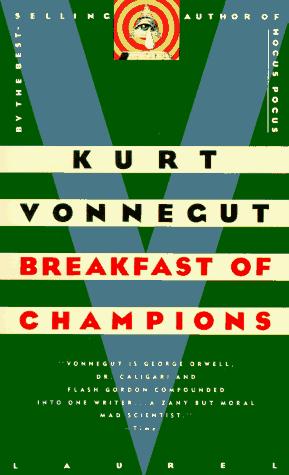
Breakfast of Champions
Kurt Vonnegut · 1922–2007 · USA
Why it matters
Kilgore Trout, Vonnegut's hack alter ego, drives cross-country toward a reunion that convinces a Midwestern car dealer his free will is fiction, while Vonnegut himself steps into the book to set his own characters loose. Metafiction staged as a nervous breakdown, doodles included.
At a glance
Childlike line drawings and a fragmented structure ease a formally radical, self-aware novel.
Deep dive
Why Vonnegut draws himself sitting at a cocktail lounge bar watching his own characters collide, and what he owes the hack science-fiction writer he's spent decades using as a punching bag.
Written for readers who have finished the book. No plot recap, and nothing here is safe to read first.
Themes & symbolism
Vonnegut narrates the entire novel as though explaining human civilization to a reader encountering it for the first time, drawing his own crude illustrations of a flag, a can of beefaroni, an asshole, treating ordinary American objects with the same anthropological flatness he'd use for an alien species' totems. The effect strips the ugliness, guns, pollution, casual racism, of its familiarity and makes it look, correctly, insane.
Two men converge on the fictional Midland City arts festival: Dwayne Hoover, a wealthy Pontiac dealer whose brain chemistry, Vonnegut's blunt, recurring explanation for cruelty throughout the book, is quietly deteriorating, and Kilgore Trout, Vonnegut's hack science-fiction alter ego, invited as guest of honor almost as a cosmic joke. Dwayne reads one of Trout's unreadable, brilliant paperbacks, which argues that everyone on Earth except the reader is a robot without free will, and takes it with total, literal sincerity, a premise Vonnegut treats less as satire of a gullible reader than as a demonstration of how easily a persuasive story, believed too completely, becomes a weapon.
Trout himself has spent decades writing exactly this kind of destabilizing premise into cheap paperbacks nobody reads seriously, stocked in adult bookstores between the pornography, his ideas wasted on a readership that only wants the covers. Vonnegut's running joke, that Trout is a genius nobody will ever recognize as one, stops being funny the moment a single reader finally does take him seriously, and takes him seriously enough to maim people with the idea.
The Author Steps Into the Bar
Vonnegut writes himself directly into the novel's final chapters, watching Dwayne's breakdown from a cocktail lounge stool, eventually revealing himself to his own creation Kilgore Trout as his literal creator. The confrontation plays less as postmodern trick than as genuine authorial guilt and repair, Vonnegut answering for the damage his own fiction, the free-will hoax Dwayne believed without question, has caused inside the story he's responsible for.
Vonnegut also uses the frame to explain, plainly, that he's turning fifty and trying to clear his head of the characters he's accumulated over a career, treating Breakfast of Champions less as a novel about Dwayne Hoover than as its author's own public housecleaning, conducted in front of the reader instead of privately. The drawings, the childlike explanations of ordinary objects, the interruptions, all read differently once it's clear Vonnegut isn't performing detachment from his material so much as trying to set it down.
The last seal: what actually happens, and why it lands the way it does.
The ending, explained
Dwayne, having absorbed Trout's book as literal truth, goes on a beating spree through the festival grounds, maiming several people including his own son and biting off part of a stranger's finger, before being subdued. Trout, injured in the attack, is confronted afterward by Vonnegut himself, who apologizes, grants him fictional freedom from authorial control, and sends him, in the novel's last words, out of the book pleading to be made young again. Vonnegut offers no tidier moral for Dwayne's violence than the bad chemicals excuse he's used all along, choosing instead to end on his own responsibility for the stories he sets loose in the world.
Where to go next
 Kurt Vonnegut · 1959The Sirens of TitanLvl 4Fast paced
 Kurt Vonnegut · 1961Mother NightLvl 4Fast paced
 Kurt Vonnegut · 1963Cat's CradleLvl 4Fast paced
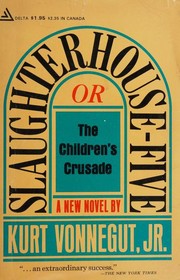 Kurt Vonnegut · 1969Slaughterhouse-FiveLvl 5Fast paced
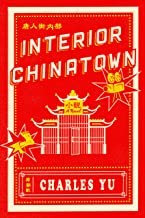 Charles Yu · 2020Interior ChinatownLvl 5Fast paced
 Haruki Murakami · 1987Norwegian WoodLvl 3Fast paced