
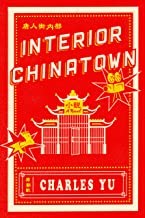
Interior Chinatown
Charles Yu · b. 1976 · United States
Why it matters
Background actor Willis Wu cycles endlessly through Hollywood's narrow catalogue of Asian stereotypes, his entire life scripted, literally, as a screenplay. Yu's formally inventive National Book Award winner turns typecasting into an inescapable life sentence.
At a glance
Unconventional screenplay formatting takes some adjustment despite otherwise brisk, readable prose.
Deep dive
Why Willis Wu's whole life comes formatted as a cop-show script, and why 'Kung Fu Guy' — the role he's spent decades chasing — turns out to be the trap, not the reward.
Written for readers who have finished the book. No plot recap, and nothing here is safe to read first.
Themes & symbolism
Yu writes the novel as an actual screenplay for a procedural called Black and White, and the joke sharpens with every scene heading: Willis Wu doesn't have a life outside the show, because Hollywood's casting logic is the only vocabulary the book allows him. He climbs a ladder of parts — Background Oriental Male, Dead Asian Man, Striving Immigrant, Disgraced Son — toward the ceiling role every background actor covets, Kung Fu Guy, and the novel's cruelest structural joke is that Kung Fu Guy is still a part, still written by someone else, still confined to a few minutes of screen time before the white leads take the story back. Wanting to be seen and wanting to be free turn out to be different, incompatible ambitions, and Willis spends most of the book unable to tell them apart.
The show's title does real work: Black and White stages the American racial imagination as a two-character procedural with no speaking part for anyone in between, so Willis's father, once a minor martial-arts legend billed as Sifu and now aged into an extra even less visible than his son, becomes the book's quieter tragedy — a man who crossed an ocean and still ended up scenery. The generational arc runs backward from the immigrant-uplift story Hollywood likes to tell: each generation of Wu men gets smaller parts, not bigger ones.
Willis's romance with Karen, a mixed-race colleague who can pass in and out of the show's racial categories in a way he can't, sharpens the trap further: her flexibility reads as freedom from where Willis stands, but the novel is careful not to let her escape cleanly either, since the show still assigns her value based on how legible she is to the categories it runs on. Their daughter, born between the show's rigid slots, becomes a small, hopeful glitch in a system built to reproduce the same handful of roles indefinitely — proof that the categories can slip, even if the industry keeps issuing new scripts to reinforce them.
Stage Directions as Racism
Yu's formal choice — present-tense stage directions, scene headings, camera blocking — does the satire's heavy lifting: when a script literally instructs BACKGROUND ORIENTAL MALE to reappear on a fire escape, or has the show's producers debate whether Willis reads as sufficiently 'Chinese,' the mechanics of racial casting are exposed as just that, mechanics, decided off-page by people who never appear as characters at all. The industry becomes visible as an apparatus precisely because the prose refuses to let it hide inside ordinary narration.
Turner and Green, or the Buddy-Cop Binary
The show's Black detective and white detective get their own emotional arcs, their own cases solved week to week — the actual protagonists of the genre Willis is trapped inside. Yu isn't satirizing them so much as the binary itself: a screen, and a national imagination, built for exactly two racial positions, into which Asian America has never been written a speaking role, only set dressing labeled by generic function.
The last seal: what actually happens, and why it lands the way it does.
The ending, explained
In its final stretch the novel breaks its own format: a courtroom-like proceeding puts the show's entire casting logic on trial, forcing into the open what the script has kept as background business all along — the roles assigned, the ceiling imposed, the generations of men, including Willis's own father, spent as scenery. The screenplay conventions that structured every prior page start to fail, stage directions giving way to something closer to direct address, as Willis is pushed to answer for himself outside any part he's been handed. He doesn't escape the industry so much as refuse, for the first time, to audition for its next role — reaching for a version of his story he authors rather than one cast for him, his father's unlived ambitions folded into what he finally claims for himself.
Where to go next
 Kurt Vonnegut · 1969Slaughterhouse-FiveLvl 5Fast paced
 George Saunders · 2017Lincoln in the BardoLvl 7Medium pace
 Shehan Karunatilaka · 2022The Seven Moons of Maali AlmeidaLvl 6Fast paced
 Jason Mott · 2021Hell of a BookLvl 5Medium pace
 John Irving · 1978The World According to GarpLvl 4Fast paced
 Percival Everett · 2001ErasureLvl 6Fast paced