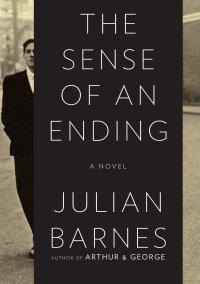
The Sense of an Ending
Julian Barnes · b. 1946 · England
Why it matters
A complacent retiree receives a strange bequest that unravels his tidy account of his own youth. Barnes's Booker winner: a slim, devastating study of how memory flatters, edits, and lies.
At a glance
Short and clear, but its unreliable retrospection rewards a wary second look.
Deep dive
Why Tony Webster's account of his own past is the novel's real crime scene, and how a scrap of an old philosophy formula becomes its proof of guilt.
Written for readers who have finished the book. No plot recap, and nothing here is safe to read first.
Themes & symbolism
Tony Webster narrates his own youth as a story about a clever, doomed friend and a fumbled early relationship, and Barnes's whole method is to let that account sound plausible — reasonable, self-deprecating, faintly rueful — while quietly seeding the evidence that Tony is not the passive bystander he claims to be. His schoolboy discussions of history with his teacher Old Joe Hunt supply the novel's thesis outright: history is the certainty produced at the point where the imperfections of memory meet the inadequacies of documentation, which is exactly the gap Tony has been living inside for forty years, undisturbed, until Veronica's mother's strange bequest forces the documentation back into view. The title itself borrows from the critic Frank Kermode's study of how narratives impose false, comforting shape on the shapeless middle of a life — Tony is an amateur historian of himself, and like any bad historian he has quietly edited out the parts that implicate him.
The Severn Bore — a tidal wave that runs backward up a river, against the current, which Tony and his friends go to watch as students — is the novel's clearest image for what memory eventually does to Tony: time that should only run one direction reverses and floods back over ground he thought was settled. What it floods is the letter: the vicious note Tony sent Adrian and Veronica when they got together, wishing them ill and pointedly suggesting Adrian go ask Veronica's mother about the family's damage. Tony has spent decades remembering himself as merely stung and eventually resigned; the letter, when it resurfaces, proves he was active, articulate, and cruel — and that his cruelty may have set in motion the very events he's spent his life mourning without ever connecting to himself.
The Diary Fragment's Cruel Arithmetic
The single surviving page of Adrian's diary that Veronica allows Tony to see contains a philosophical formula treating a chain of romantic decisions as something almost calculable, closing on the line "there is accumulation. There is responsibility." Adrian, training as a philosopher, wanted to reason his way to a precise account of blame; Barnes gives the reader only this one incomplete fragment, which is the whole novel's method in miniature — a single surviving document standing in for a fuller truth nobody, including Tony, will ever fully retrieve.
An Unreliable Narrator Who Doesn't Know He's Lying
Tony isn't villainous in the way of a conventional unreliable narrator hiding a secret from the reader on purpose — he genuinely doesn't remember writing the letter as cruelly as he did, and the novel's real subtlety is showing repression rather than deception. When Veronica finally forces him to reread it, his shock reads as authentic: he has successfully lied to himself for decades, which Barnes suggests is the far more common, and far more comfortable, way people falsify their own histories.
The last seal: what actually happens, and why it lands the way it does.
The ending, explained
Piecing together Veronica's fury, her mother Sarah's bequest, and a visit to a group home where he meets a damaged young man named Adrian, Tony finally understands what he'd spent decades not letting himself see: after Adrian took up with Veronica, he also became involved with her mother, Sarah, and the two had a son — the Adrian he's just met — before Adrian Sr.'s reasoned, deliberate suicide. Tony's cruel letter, telling Adrian to go ask Sarah about the family's damage, appears to have set that chain in motion, making him not the wounded, peripheral figure of his own story but an active cause of it. Barnes refuses Tony, and the reader, full closure — the diary stays withheld, motives stay unconfirmed — leaving Tony with accumulation and responsibility but no tidy final accounting, exactly the ending his own storytelling had spent the whole book trying to avoid.