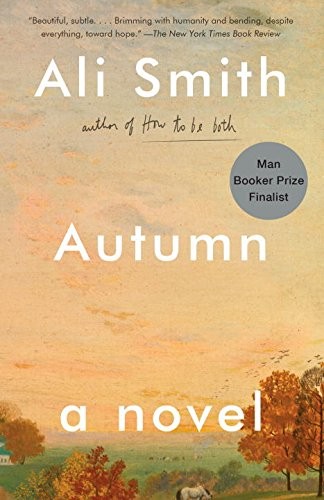
Autumn
Ali Smith · b. 1962 · Scotland
Why it matters
Elisabeth's decades-long friendship with her dying, much older neighbor Daniel unspools through memory, forgotten Pop Art, and a Britain freshly split by the Brexit vote. Smith's Seasonal Quartet opener became the first major novel to answer the referendum almost as it happened.
At a glance
Fragmented, associative structure and free-ranging allusion ask for patience despite plain sentences.
Deep dive
A young woman visits her oldest friend, more than seventy years her senior and slipping in and out of sleep in a care home, and Smith writes the friendship, and the country outside it, entirely in fragments.
Written for readers who have finished the book. No plot recap, and nothing here is safe to read first.
Themes & symbolism
Elisabeth Demand's friendship with her elderly neighbor Daniel Gluck, which began when she was a child assigned him for a school project and he took her seriously in a way few adults did, is narrated across decades out of order, Smith cutting between Elisabeth's childhood conversations with Daniel, her present-day visits to him in a care home where he mostly sleeps, and Daniel's own drifting, half-dreamed memories of his sister Hannah's disappearance in occupied France. The nonlinear structure isn't ornamental; it argues that a long friendship doesn't live in chronological order any more than memory does.
Pauline Boty, the real Pop artist Daniel introduces Elisabeth to as a child and whose forgotten work becomes the subject of Elisabeth's academic career, gives the novel its clearest thematic anchor: Boty, the only woman among the British Pop artists of the 1960s, died young of cancer and was largely written out of the movement's history until decades of rediscovery, and Smith uses her erasure and recovery to ask what else, and who else, a culture quietly decides isn't worth remembering.
Around Elisabeth and Daniel, Smith stages post-referendum Britain almost entirely through bureaucratic friction, a passport office queue that swallows entire chapters, a fence newly built around a stretch of common land, neighbors who stop speaking to each other over how they voted, and refuses to let any character deliver a tidy verdict on Brexit itself; the fracture shows up as texture, delay, and small daily cruelty rather than as debate.
A Fence Where There Wasn't One
The new fence built around a patch of common land Elisabeth and her mother used to walk becomes the novel's most concrete image of the referendum's aftermath, cutting off a shared, unremarkable public space for reasons no one in the village can quite explain to her satisfaction. Smith lets the fence stand for the whole book's argument about division: it's arbitrary, barely justified, and instantly, physically real, the opposite of an abstraction.
Writing a Country as It Happened
Smith drafted and published Autumn within months of the June 2016 referendum, an unusually fast turnaround for a literary novel that let her fold in details, the immediate queues, the graffiti, the raw local shock, still current rather than filtered through years of hindsight. The speed is part of the Seasonal Quartet's whole design, four novels written and released close to their own present tense, and Autumn's opening volume set the method: fiction fast enough to still be describing wet paint.