
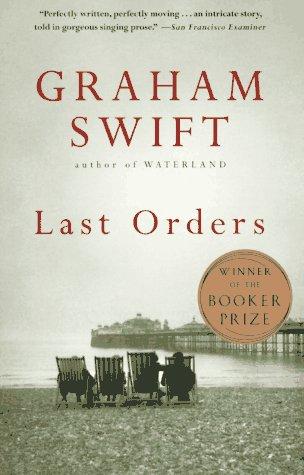
Last Orders
Graham Swift · b. 1949 · England
Why it matters
Four Bermondsey men drive a butcher's ashes to Margate pier, the day's detours opening into fifty years of war, love, and betrayal. Booker winner in 1996: working-class London given the rotating-voice architecture of Faulkner, and equal gravity.
At a glance
Seven rotating vernacular narrators and shuffled chronology, in plain pub English.
Deep dive
Why four men driving a butcher's ashes to the seaside sounds like a joke setup, and how Swift turns it into Faulkner relocated to a Bermondsey pub.
Written for readers who have finished the book. No plot recap, and nothing here is safe to read first.
Themes & symbolism
Swift borrows his structure almost as an open homage — rotating first-person chapters carrying a body, or here its ashes, toward burial across a single day's journey is As I Lay Dying's shape exactly — and the borrowing makes an argument of its own: that four ordinary Bermondsey men, an insurance clerk, a butcher's assistant, an undertaker, a car dealer, deserve the same formal seriousness Faulkner gave the Bundrens. Each voice gets its own rhythm and blind spots — Ray's diffidence, Vince's defensiveness, Lenny's grievance, Vic's undertaker's calm — and the gaps between what one man notices and what another withholds are where the real story lives, since none of them, across fifty years of friendship, has ever said the important things to each other directly.
The novel's real subject is what postwar English working-class masculinity trained these men never to say aloud — grief, desire, doubt about who fathered whom — so the drive to Margate becomes a day-long exercise in circling feeling without naming it, jokes and pub stops standing in for the eulogy none of them know how to deliver straight. Margate's pier, a faded seaside-holiday landmark jutting out over the water where England traditionally goes to relax rather than to mourn, becomes the novel's makeshift altar: a resolutely unsacred, unglamorous stage for scattering Jack's ashes that suits men with no other vocabulary for ceremony, the sea itself standing in for whatever afterlife or dissolution none of them can quite claim to believe in.
What the Detours Reveal
The literal route to Margate keeps bending — a stop at a war memorial, a diversion through the hop fields of Kent where Ray and Jack once picked together, a fraught visit to a cathedral — and each detour peels back another layer of the men's shared history, including the long, carefully unspoken fact that Ray had an affair with Jack's wife Amy and that Vince's parentage is quietly, permanently in doubt. Swift never forces a confession scene; the novel trusts the accumulation of flashback fragments to do what none of the characters could do directly, letting the reader arrive at the buried truths well before any of the men would ever say them aloud to each other.
Winning the Booker, Answering a Debt to Faulkner
Last Orders took the 1996 Booker Prize, but its acclaim was shadowed by accusations that Swift had leaned too heavily on As I Lay Dying's structure without sufficiently acknowledging the debt — a controversy that, in retrospect, undersells what Swift actually does with the borrowed form. Where Faulkner's Mississippi is gothic and violent, Swift's London and Kent are drably ordinary, and the transplantation is the point: English reticence, rationed love, and class immobility get the same tragic architecture American Southern gothic once claimed as its own territory.
The last seal: what actually happens, and why it lands the way it does.
The ending, explained
The four men reach Margate pier and, in a moment played for both comedy and real feeling, fumble briefly over how to actually scatter human ashes into a stiff coastal wind before finally releasing Jack into the sea, the last of him blowing back across them as much as out over the water. It's a deliberately unglorious ending — no eulogy, no closure delivered in speech, just an ordinary English seaside gesture standing in for everything the day's flashbacks have shown these men could never quite say to Jack, or to each other, while he was alive. The ashes disperse into a sea that doesn't care about the affairs, grievances, and buried paternity the novel spent its length excavating, which is exactly Swift's point about what survives and what doesn't.
Where to go next
 Julian Barnes · 2011The Sense of an EndingLvl 4Medium pace
 Alan Hollinghurst · 2004The Line of BeautyLvl 5Slow burn
 Howard Jacobson · 2010The Finkler QuestionLvl 5Medium pace
 Ali Smith · 2016AutumnLvl 5Slow burn
 António Lobo Antunes · 1979The Land at the End of the WorldLvl 8Slow burn
 William Faulkner · 1930As I Lay DyingLvl 9Medium pace