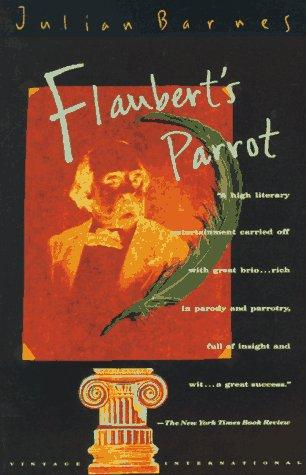
Flaubert's Parrot
Julian Barnes · b. 1946 · England
Why it matters
A grieving doctor chases the stuffed parrot Flaubert kept on his desk, and the impossibility of ever knowing a life. Barnes's genre-bending blend of biography, essay, and fiction.
At a glance
Essayistic digressions and non-chronological fragments dissolve the usual novel shape.
Deep dive
A retired doctor sets out to track down the actual stuffed parrot Flaubert supposedly kept on his desk, and the search keeps leading him back to a story about his own marriage he can't quite bring himself to tell directly.
Written for readers who have finished the book. No plot recap, and nothing here is safe to read first.
Themes & symbolism
Geoffrey Braithwaite's search for the taxidermied parrot Flaubert reportedly borrowed from the Rouen museum and kept on his desk while writing Un Coeur Simple sounds at first like literary trivia, and Barnes lets it stay funny for exactly as long as it takes to become something else: when Geoffrey discovers two separate museums both displaying a stuffed parrot each claims is the authentic one, the joke curdles into the novel's real argument, that biography itself, the effort to pin down one true fact behind a writer's fiction, keeps running into exactly this kind of unresolvable duplication. Barnes builds the novel out of fragments rather than continuous narrative on purpose: timelines, a bestiary of Flaubert's animal imagery, an exam paper, contradictory chronicles of Flaubert's life told from opposing angles, because a linear biography would claim a false confidence Geoffrey, and Barnes, refuse to grant the form.
Threaded almost invisibly through the parrot chase is the slowly surfacing fact of Geoffrey's own marriage: his wife Ellen had a series of affairs and eventually took her own life, and Geoffrey, a man professionally trained to diagnose other people's bodies, can produce a meticulous chronology of Flaubert's mistresses and correspondence while conspicuously failing to organize a coherent account of his own wife's death. That avoidance is the novel's real subject disguised as literary detective work: Geoffrey pursues Flaubert's supposed objectivity, the famous ambition to write like God in the universe, present everywhere and visible nowhere, precisely because his own experience has been the opposite, an unbearable visibility inside a grief he has no critical distance from at all.
Three Different Flauberts, Told Three Times
Barnes gives the novel three separate chronologies of Flaubert's life in quick succession, one framing each event as evidence of a life crowned with success, the next framing the identical set of facts as a catalogue of loss and disappointment, forcing readers to watch the same raw material produce opposite verdicts depending only on which adjectives a biographer chooses to attach to it. The device does double duty: it's a genuine essay on how biography manufactures certainty out of selection, and it's also Geoffrey's own defense mechanism laid bare, since a man who can prove that any life admits multiple contradictory tellings has also quietly given himself permission never to settle on a single true account of his own marriage.
The last seal: what actually happens, and why it lands the way it does.
The ending, explained
Late in the novel, in the chapter titled "Pure Story," Geoffrey finally narrates Ellen's affairs and suicide directly and chronologically, the one moment the book abandons its scattered, essayistic structure to tell something straight, and the plainness of that chapter, arriving after two hundred pages of digression, lands harder for the deferral. Geoffrey's parrot hunt resolves with equal anticlimax: a museum curator eventually tells him that at least three stuffed parrots were available to Rouen's museum during Flaubert's lifetime, meaning the authentic one, if it can even still be identified at all, is most likely lost among specimens indistinguishable from each other. Barnes closes on Geoffrey accepting that some things, a writer's true desk, a wife's true reasons, simply don't survive into the record clearly enough to be recovered, and that the honest response isn't grief resolved but grief precisely, permanently, unresolved.