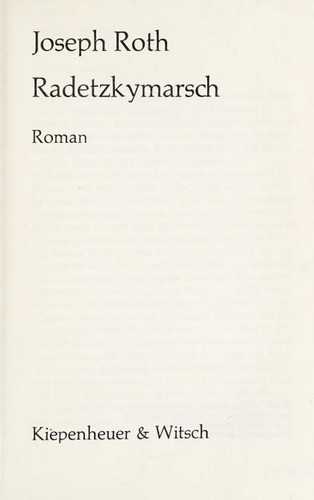
The Radetzky March
Joseph Roth · 1894–1939 · Austria (Galicia)
Originally Radetzkymarsch (German)
Why it matters
Three generations of the Trotta family rise and fall with the Habsburg empire, to the beat of Strauss's march. The great elegy for Mitteleuropa: an empire's dissolution measured in one loyal family's decline.
At a glance
Elegant but unhurried multigenerational realism with a large cast of officers and officials.
Deep dive
The march plays at every Sunday concert in the book, getting hollower each time — Roth's clock for measuring exactly how far an empire's self-image has drifted from what's actually left standing.
Written for readers who have finished the book. No plot recap, and nothing here is safe to read first.
Themes & symbolism
Roth builds the novel around a single accidental act — Joseph Trotta shielding the Emperor's body at Solferino — and then spends three generations watching a family fail to metabolize an honor that was never earned in any way they can repeat. The district commissioner turns his father's legend into rigid duty; Carl Joseph, handed the myth without any equivalent act of his own, has nothing to do with it but drift, gamble, and drink, because inherited honor with no fresh occasion to prove itself curdles into pure aimlessness. The gap between the founding legend and the diminishing men who carry its name is the novel's real subject, more than any single plot event.
The Radetzky March itself, played at every garrison Sunday concert, works as the book's clock — a triumphal tune from an earlier war, performed with straight-faced ceremony in a present that has nothing left to triumph about. Its recurrence measures how far behind reality the empire's self-image has fallen, right up until the coming war makes the tune actually obscene rather than merely nostalgic. Roth extends the same elegiac tenderness to the empire's minor bureaucrats, garrison towns, and multiethnic texture that he gives the Trottas, so the family's decline and the empire's dissolution read as the same event seen at two different scales.
Three generations, three kinds of exhaustion
Roth doesn't just repeat one failure across generations, he escalates its form — the grandfather's stubborn honesty (refusing to let his heroism be mythologized in schoolbooks) curdles into the father's rigidity, which curdles into the grandson's total disengagement. Each generation trusts the previous one's certainties a little less, and by Carl Joseph there's no certainty left to inherit at all, only a uniform and a march tune standing in for a belief system that quietly evacuated itself a generation earlier.
Empire as weather
The novel treats the Habsburg empire's ethnic and linguistic patchwork — Slovenes, Poles, Ruthenians, Italians all under one increasingly notional crown — not as background but as the actual body dying alongside the Trottas, felt in provincial garrisons and border towns rather than any Vienna throne-room scene. Roth's elegy is for a whole plural, workable civilization, not merely for one family's fortunes.
Franz Joseph himself drifts through the novel as a distant, aging figure whose own vitality is visibly running out on the same clock as his empire's, so that the emperor's body and the Trottas' fortunes and the map of Central Europe all read as three faces of a single, slow expiration. Roth never needs to state the parallel outright; it's built into the structure by simple accumulation, one generation and one border garrison at a time.
The last seal: what actually happens, and why it lands the way it does.
The ending, explained
Carl Joseph dies in one of the war's first, most futile skirmishes, shot fetching water for his men rather than in any charge or act of command — Roth pointedly denies him the heroic death his grandfather's legend would seem to promise, making clear the family's founding myth was never a template anyone since could actually reenact. His father receives the news and dies himself soon after, his whole worldview of loyalty and service collapsing with no successor left to hold it. The empire's actual 1918 dissolution follows close behind, so the Trotta line and the Habsburg monarchy expire together, neither with any ceremony left to mark it. Roth withholds any redemptive final gesture; the last generation simply stops, mid-sentence, the way the empire itself stopped rather than concluded.