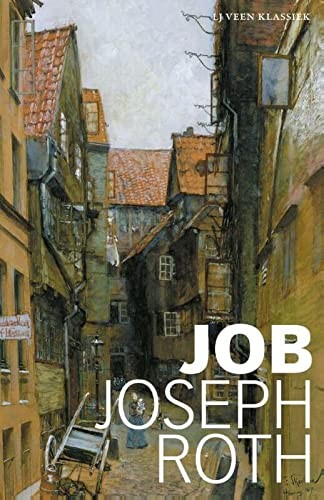
Job
Joseph Roth · 1894–1939 · Austria (Galicia)
Originally Hiob (German)
Why it matters
A pious Jew from a Russian shtetl loses nearly everything he loves and rebuilds a life, faith in ruins, on the far side of the Atlantic. Roth retells the Book of Job as a tender, unsentimental fable of catastrophe and exile.
At a glance
A parable-like fable structure told in clean, folkloric prose.
Deep dive
A poor Hebrew teacher watches his family scatter and break across a shtetl, a war, and an ocean crossing, and Roth rewrites the Book of Job with a modern immigrant's catastrophes standing in for the whirlwind.
Written for readers who have finished the book. No plot recap, and nothing here is safe to read first.
Themes & symbolism
Mendel Singer teaches Hebrew to children in the shtetl of Zuchnow, poor but devout, and the novel's early chapters establish a household already marked by one visible catastrophe: his youngest son Menuchim is born with a severe disability, epileptic and unable to speak, and a local wonder-rabbi tells Mendel not to give up on the boy, that he will one day be healed and become wise. Roth stages the family's slow unraveling as a direct, almost point-by-point modern rewriting of the biblical Job, misfortune arriving not from a divine wager but from the ordinary historical machinery of conscription, pogrom, and emigration, so that the theological question, why does a devout man suffer, gets asked without any of scripture's supernatural framing to answer it.
The family emigrates to America to escape the draft, but Menuchim, unable to travel, stays behind in a relative's care, and America itself becomes the site of Job's real trial rather than its escape: Mendel's son Shemaryah, remade as the successful American Sam, is drafted into the First World War and killed; his daughter Miriam's mind gives way; his wife Deborah dies of grief. Mendel's response is not pious endurance but open, furious renunciation, casting aside his prayer articles and declaring God cruel, a crisis of faith Roth lets sit, unresolved and unforgiven, for the length of the novel's darkest chapters.
A Whirlwind Replaced by a Concert Hall
The Book of Job answers its sufferer with a voice out of the whirlwind that refuses to explain anything and simply asserts the scale of creation against the scale of one man's grief. Roth's novel answers Mendel with something smaller and stranger: Menuchim, given up for a hopeless invalid decades earlier, turns out to have been healed exactly as the wonder-rabbi predicted, and reappears, at the novel's end, as a celebrated composer and conductor searching for the family he was separated from. It is Roth's most sentimental structural choice and his most deliberate one, an author who spent his career mourning vanished worlds choosing, once, to let one shattered family get its miracle.
The last seal: what actually happens, and why it lands the way it does.
The ending, explained
Word reaches Mendel, now reduced to a beggarly existence and still refusing to pray, that a famous musician touring America wants to meet him, and the man who arrives is Menuchim, transformed from the disabled child left behind in Zuchnow into an acclaimed, articulate adult, exactly fulfilling the wonder-rabbi's old prophecy that suffering was not this son's final condition. Roth stops short of restoring Mendel's faith outright; the reunion reads as much like exhausted relief as religious vindication, an old man too worn down by the rest of the book's losses to do anything with the miracle except accept it, which is itself Roth's quiet argument that grace, when it finally comes, rarely announces itself as anything grander than one more thing that simply happens to a person who has stopped expecting anything at all.